


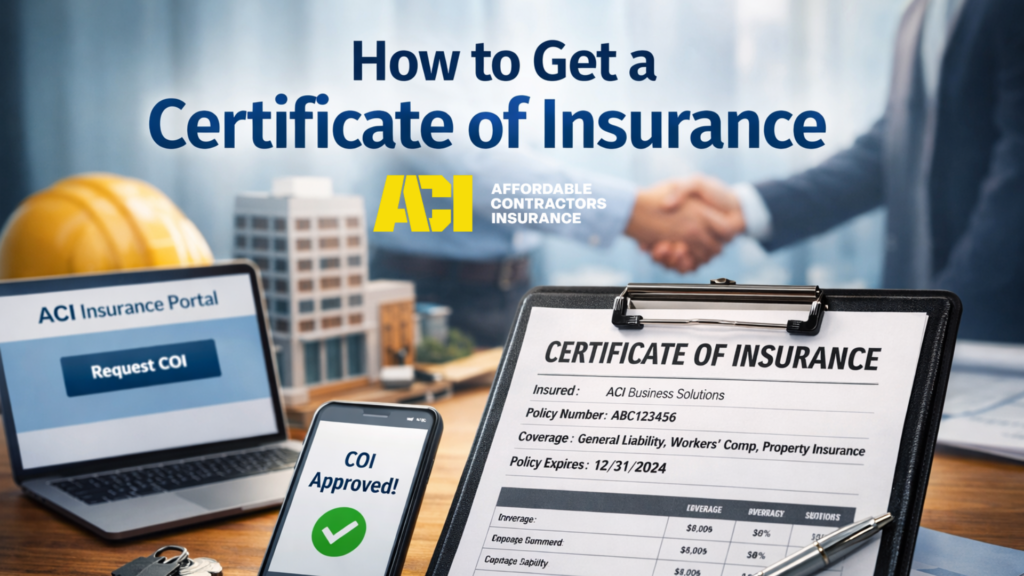
If you need a Certificate of Insurance (COI) fast, the biggest “delay drivers” are usually simple: missing project details, incorrect certificate holder information, or a request that needs an endorsement (like Additional Insured) before the COI can be issued. The good news is this is fixable—quickly—when you know what to prepare and what to request.
At Affordable Contractors Insurance (ACI), certificates are treated like jobsite infrastructure. Contractors don’t have time for back-and-forth when a GC, landlord, or municipality needs proof of coverage to release a permit, schedule a start date, or approve access. This guide walks you through what a COI is, why it matters, what information it includes, how to request one through ACI, and how to avoid the common errors that cause certificate rejections.
If you’re under a deadline and need help getting the right certificate issued the right way, use ACI’s request-a-quote / request-help workflow so our team can align your COI to the contract requirements and issue it without delays.
Request Certificate Help Now
If a job is waiting on your COI (or you need Additional Insured / Waiver of Subrogation wording), request help through ACI so we can issue the correct certificate for the exact requirement set.
What Is a Certificate of Insurance (COI)?
A Certificate of Insurance (COI) is proof that your business has active insurance coverage. It’s a standardized document that summarizes your policy information in a format clients, general contractors, property managers, and compliance teams recognize immediately.
A COI typically includes:
- Your business name and mailing address (the insured)
- Your insurance carrier information
- Policy numbers for each line of coverage
- Effective dates and expiration dates
- Coverage types (general liability, workers’ comp, commercial auto, umbrella, etc.)
- Policy limits (per occurrence, aggregate, and any required sub-limits)
- Certificate holder information (who is receiving the certificate)
- Special wording and endorsements (when applicable)
A COI is not the insurance policy itself. It’s a snapshot used to confirm coverage exists, that it’s active, and that it meets baseline requirements for a job, lease, or contract.
Why a COI Matters for Contractors
A COI is more than paperwork—it’s often the “permission slip” that allows work to begin. In construction and contracting, a certificate can determine whether you can:
- Get approved as a vendor or subcontractor
- Start a jobsite on schedule
- Pull a permit or pass a compliance review
- Sign a contract or satisfy insurance provisions
- Maintain a commercial lease
- Avoid payment holds tied to compliance documentation
When COIs are delayed or incorrect, contractors can lose momentum fast. That’s why the goal isn’t just “get a COI.” The goal is get the right COI—with the right certificate holder, wording, and endorsements—so it’s accepted the first time.
If your GC or client is asking for specific language (Additional Insured, Primary & Noncontributory, Waiver of Subrogation), request a quote or request certificate help through ACI so we can structure it correctly.
Client Assurance and Trust
Clients and project owners want to reduce risk. A COI helps them confirm you’re insured before they let you:
- step onto a jobsite,
- access a facility,
- begin operations, or
- take responsibility for work that could create liability.
Providing a COI quickly and accurately signals:
- you’re operationally ready,
- you understand compliance,
- you manage risk like a professional,
- and you can meet contract requirements without friction.
That “signal” matters. Contractors who consistently deliver clean compliance paperwork tend to win more work because they are easier to onboard and easier to manage.
COIs as a Risk Management Tool
A COI supports risk management in two directions:
- It protects you by confirming you have active coverage aligned to the scope of work.
- It protects the other party by showing you carry the required insurance and limits, and by documenting endorsements when they’re required by contract.
COIs also reduce exposure when you’re hiring subs. Many contractors collect COIs from subcontractors to confirm:
- workers’ comp is active,
- general liability limits meet project requirements,
- and there aren’t obvious coverage gaps.
A clean COI process is one of the simplest ways to reduce preventable compliance problems that can turn into expensive disputes later.
COIs as a Contractual Compliance Requirement
In many contracting scenarios, COIs are non-negotiable:
- General contractors often require COIs before onboarding subs
- Property managers require COIs before granting access or approving build-outs
- Municipalities and certain clients require COIs for permits or regulated work
- Master Service Agreements may require specific endorsements to be reflected on the certificate
A COI is often tied to a “no COI, no work” reality. If the certificate is missing required wording, you may be asked to reissue it—which costs time and can delay your start date.
Types of Certificates of Insurance
COIs generally fall into two categories:
Basic COIs
Basic COIs provide general proof of coverage and are often used for:
- routine vendor onboarding,
- general record-keeping,
- low-friction client requests where no special endorsements are required.
They usually include your coverage lines, limits, and policy dates, with the certificate holder listed.
Custom COIs
Custom COIs are built to satisfy specific contract requirements. These commonly involve:
- Additional Insured wording
- Primary & Noncontributory language
- Waiver of Subrogation requirements
- Project-specific certificate holders (jobsite address, owner/GC, lender, etc.)
- Contractual wording in the description/operations section
Custom COIs are where most delays happen—because endorsements may be required before the certificate can be issued correctly.
If you’re unsure whether your request is “basic” or “custom,” request help through ACI and send the contract insurance requirements section so we can match the COI to what the client will actually accept.
What Information Is Included on a COI?
A COI is designed to be readable by compliance teams, so it focuses on standardized fields. The most important items include:
- Named insured: your legal business name (must match the policy)
- Certificate holder: the party requesting proof (GC, client, landlord, etc.)
- Carrier and NAIC: insurer identity
- Policy numbers: for each line shown
- Effective / expiration dates: proves coverage is active
- Coverage types: GL, WC, Auto, Umbrella, etc.
- Limits: per occurrence, aggregate, combined single limit, etc.
- Endorsements (when applicable): Additional Insured, Waiver, Primary/Noncontributory (often referenced and may require separate endorsement confirmation)
Before you send a COI out, the two highest-impact checks are:
- Does the certificate holder name and address match exactly what the requester provided?
- Does the COI include the correct wording/endorsements required by contract?
Why Getting a COI Quickly Matters
Contractors operate on deadlines. A COI is often requested at a moment where any delay creates a chain reaction:
- permit delays,
- job start delays,
- subcontractor onboarding delays,
- payment holds,
- and lost trust.
Fast certificate delivery can:
- keep projects moving,
- prevent admin bottlenecks,
- improve client confidence,
- and reduce “compliance friction” that costs time and money.
At ACI, the goal is simple: issue certificates cleanly, quickly, and correctly so you can focus on the work.
How to Request a COI From ACI
Requesting a COI is straightforward, but accuracy matters. The best approach is to gather the right information before you submit the request so the COI is accepted the first time.
Step 1: Verify Your Policy Is Active
A COI cannot be issued if:
- the policy is cancelled,
- the policy hasn’t started yet,
- or payment/underwriting requirements haven’t been satisfied.
If you’re unsure, ACI can confirm your policy status quickly.
Step 2: Gather the Certificate Holder Details
Most COI reissues happen because certificate holder details are incomplete or incorrect. Have ready:
- Legal name of the certificate holder
- Mailing address
- Jobsite address (if required)
- Any reference numbers (project number, vendor ID, contract ID)
Step 3: Identify Any Required Wording or Endorsements
If the requester mentions any of these, it’s a “custom COI” and may require endorsements:
- Additional Insured (AI)
- Primary & Noncontributory
- Waiver of Subrogation (WOS)
- Specific language in the description box
If you have a contract, send the insurance requirements section. That single step prevents most back-and-forth.
Step 4: Submit the Request Through ACI
You can request your COI through ACI’s workflow (or through your assigned ACI contact/team). For fastest turnaround, include all details upfront.
Step 5: Review the COI Before You Send It
Before sharing, confirm:
- certificate holder is correct,
- dates are current,
- coverage lines and limits match what’s required,
- required wording appears (if requested).
Here’s a simple process table you can follow:
| Step | Action Required | Notes |
| Verify Policy | Confirm your insurance is active | A COI can’t be issued otherwise |
| Provide Details | Submit certificate holder + jobsite info | Include any contract requirement wording |
| Confirm Endorsements | Identify if AI/WOS/Primary wording is required | May require endorsement confirmation |
| Review COI | Check accuracy before sharing | Prevents rejections + reissue delays |
If you want ACI to align your COI to a contract requirement set (and avoid rejections), request support through our quote/request workflow and attach the insurance requirements language.
Getting COIs Through Digital Access
Many contractors need certificates outside standard business hours—nights, weekends, early mornings before a job starts. Digital access helps because it reduces dependency on long email threads and makes repeat issuance simpler.
Common digital COI advantages include:
- Faster certificate retrieval
- Easier recordkeeping across multiple clients/projects
- Quick sharing via email or upload portals
- Reduced risk of using an outdated version
If you’re managing multiple jobs, a consistent workflow for COIs (and a system for tracking expiration dates) prevents last-minute issues.
How to Generate a COI Efficiently
Even when a COI can be issued quickly, the request quality determines the speed.
Use this checklist to make your COI request “first-time-approve” ready:
- Policyholder legal name matches your policy
- Certificate holder name is exact (no nicknames or abbreviations unless provided)
- Address is complete and formatted correctly
- Jobsite address included when required
- Required wording included (or contract section attached)
- Endorsements identified (AI/WOS/Primary & Noncontributory)
- Requested delivery method included (email, portal upload-ready PDF, etc.)
This approach reduces the number of revisions and keeps compliance teams from rejecting the certificate.
Adding Additional Insureds to Your COI
Adding an Additional Insured is one of the most common contractor needs—and also one of the most common sources of confusion.
What “Additional Insured” Means
When a party is listed as an Additional Insured, it typically means they may receive certain protections under your policy for liability arising out of your work—subject to the policy terms and endorsement language.
When Additional Insured Is Required
You’ll often see this in:
- subcontract agreements with GCs
- owner/GC contracts
- property management requirements for access
- vendor requirements for facility work
How to Add an Additional Insured Correctly
To avoid issues:
- provide the exact legal name and address of the party to be added,
- include the project/job reference (if applicable),
- confirm whether Primary & Noncontributory language is also required,
- and ensure the COI description reflects what the contract requests.
If a client is strict about wording, sending the insurance requirements section helps ACI match it correctly and prevent a rejected certificate.
Basic vs Custom COIs: What to Expect
Here’s a clear comparison:
| Type of COI | Purpose | Time to Obtain (Typical) |
| Basic COI | General proof of insurance | Often same-day when details are complete |
| Custom COI | Contract-specific wording and endorsements | Depends on endorsement requirements and request completeness |
Basic COIs are generally straightforward. Custom COIs depend on whether endorsements are already in place, and whether the request includes enough detail to issue it correctly the first time.
Managing Multiple COIs Across Clients and Projects
If you’re working with multiple GCs, owners, municipalities, or property managers, COIs can stack up fast. The key is to treat COIs like you treat scheduling—systematize it.
Practical ways to manage multiple COIs:
- Keep a running list of certificate holders and project names
- Track COI expiration dates alongside project schedules
- Save a copy of each issued COI in a client/project folder
- Note which clients require endorsements (AI/WOS/Primary)
- Request updates proactively before renewals and audits
If your business is growing, this isn’t optional—COI management becomes part of your operational credibility.
How to Share Your COI With Clients or Partners
Once you have the correct COI, distribution is usually simple. The main goals are speed and traceability.
Emailing Digital Certificates
Email is often the fastest method. When you send your COI, ensure:
- the PDF is the latest version,
- the COI includes the correct certificate holder,
- and any required wording is visible.
It’s also smart to keep the email thread for documentation.
Direct Sharing Options
Many contractors share COIs using:
- email,
- cloud storage folders,
- messaging apps (when clients allow it),
- or internal vendor onboarding systems.
The key is ensuring the version you share is current and matches the contract requirement set.
Uploading to Client Portals
Some clients require uploading COIs into a portal. If that’s the case:
| Step | Action | Notes |
| Prepare the COI | Have a clean PDF copy ready | Use the most recently issued version |
| Check portal requirements | File format + size limits | Some portals reject large scans |
| Upload and confirm | Submit + verify receipt | Screenshot confirmation if needed |
Portals are strict. If a portal rejects your COI, it’s often due to missing wording, incorrect certificate holder info, or dates that don’t align with the contract window.
Common Reasons Businesses Require a COI
COIs are commonly required for:
- contractor onboarding (GCs, owners, municipalities)
- commercial leases (landlords and property managers)
- vendor access (facilities, schools, hospitals, industrial sites)
- regulated work (where proof of insurance is mandatory)
- project finance requirements (lenders or project stakeholders)
In many cases, the COI requirement isn’t personal—it’s compliance. They need documentation in their system to reduce risk exposure.
How to Ensure Your COI Is Accurate Before Sharing
Before you share your COI, do these checks:
- Confirm your business name and address are correct
- Confirm the certificate holder name and address are exact
- Confirm coverage types shown match what’s required
- Confirm limits match contract minimums
- Confirm effective dates are current and not expired
- Confirm any Additional Insured parties are listed correctly
- Compare against your declarations page if anything looks off
A COI that’s “almost right” is often treated as “not accepted.” Accuracy prevents reissue delays.
Maintaining and Updating Your COI
COIs should be treated as living documentation. Policies renew, limits change, businesses grow, and project requirements shift.
Why Regular Updates Matter
Keeping your COI current:
- reduces compliance problems,
- improves client confidence,
- and prevents last-minute scrambling when a job is ready to start.
If your coverage changes—new vehicle, higher payroll, expanded operations, new entity structure—you may need updated certificates.
Tracking Expiration Dates
A simple system works:
- Set reminders 30 days before renewal
- Keep a digital log of active policies and renewal dates
- Request updated COIs immediately after renewal to avoid sending outdated certificates
Digital Access Benefits
Digital COI access supports:
- instant retrieval,
- faster sharing,
- fewer “lost certificate” issues,
- and better organization across multiple projects.
Conclusion
A Certificate of Insurance is one of the most important compliance documents contractors deal with—and it’s often tied directly to whether a job can start. When you request a COI with complete certificate holder details and any contract-required wording, you reduce reissues, prevent delays, and keep your operation moving.
If you need a COI issued quickly, or you’re not sure whether your request requires endorsements like Additional Insured or Waiver of Subrogation, route it through ACI so we can match the certificate to the requirement set and get you a version that’s accepted the first time.
If you want, paste the exact COI requirements language your GC/client sent (even just the bullet list), and I’ll rewrite it into a clean “send to ACI” certificate request message that includes everything needed to issue it correctly.
