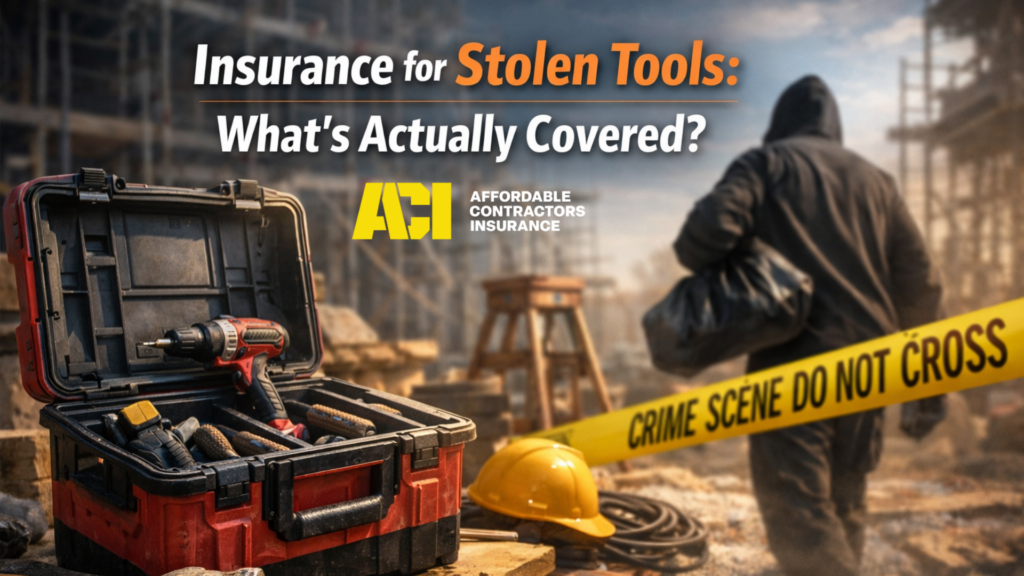
For contractors, tools are not personal property. They are production infrastructure.
When tools are stolen, projects pause. Crews wait. Deadlines move. Revenue tightens. Tool theft is not an inconvenience — it is operational disruption.
Insurance for stolen tools is not about replacing equipment. It is about protecting continuity.
If your tools travel between trucks, job sites, storage units, and subcontractors, your exposure is mobile. Your insurance must be structured accordingly.
If your equipment values have changed in the past year,
What Is Tools and Equipment Insurance?
Tools and Equipment Insurance — often written as Contractors Equipment or Inland Marine coverage — protects movable equipment that travels with your business.
Standard commercial property policies are written for fixed addresses. Contractors rarely operate from a single fixed location.
Tools coverage is designed to follow your equipment wherever revenue is generated.
A properly structured policy typically protects against:
- Theft
- Vandalism
- Accidental damage
- Transit loss
- Off-site storage exposure
If your current policy only lists your office address, your tools in trucks or on job sites may not be fully protected.
What Is Covered When Tools Are Stolen?
When structured correctly, contractor tools insurance typically responds to:
- Theft from a locked vehicle
- Theft from a job site
- Theft from temporary storage
- Theft during transportation
- Theft of loaned equipment (depending on policy language)
Coverage can apply on either:
- Replacement cost basis
- Actual cash value basis
The structure matters.
Scheduled vs. Unscheduled Coverage
There are two common ways tools are insured.
Unscheduled Coverage
Lower-value tools are grouped under a blanket limit. Individual item listing is not required.
Scheduled Coverage
Higher-value tools must be individually listed with assigned values.
If you operate with specialty saws, advanced diagnostic equipment, generators, or high-value trade tools, relying solely on a blanket limit can create exposure gaps.
If you’re unsure whether your limits reflect today’s replacement cost,
What Types of Tools Are Typically Insured?
Most contractor equipment policies cover tools that generate daily production.
This commonly includes:
- Hand tools
- Power tools
- Landscaping equipment
- Portable generators
- Compressors
- Light construction machinery
Certain heavy machinery may also be covered but often requires scheduling and underwriting review.
As operations grow, tool concentration increases. Insurance limits should grow accordingly.
Get a coverage review aligned with your current inventory here:
How Theft Claims Typically Work
When theft occurs, documentation and timing are critical.
A typical process includes:
- Filing a police report immediately
- Notifying your carrier promptly
- Providing receipts, serial numbers, and photos
- Verifying forced entry if applicable
Carriers evaluate whether policy conditions were met, including security requirements.
Contractors who maintain organized equipment logs experience faster claim resolution.
Does the Policy Cover Accidental Damage?
Theft is only one exposure.
Most tools and equipment policies also respond to sudden accidental damage, such as:
- Drops
- Impact damage
- Fire-related loss
- Certain weather events
However, normal wear and tear is not covered.
Insurance responds to sudden and accidental loss — not deterioration from use.
What About Rented Equipment?
Growing contractors frequently rent tools or machinery for larger projects.
Rental agreements often transfer full responsibility for theft or damage to the contractor.
Some policies automatically extend limited rented equipment coverage. Others require:
- A specific endorsement
- Defined sub-limits
- Separate reporting
If you regularly rent lifts, generators, specialty tools, or equipment, this exposure should be reviewed deliberately.
What Is Not Covered?
Understanding exclusions is essential.
Most contractor tools policies exclude:
- Normal wear and tear
- Intentional acts
- Employee dishonesty (unless endorsed)
- Certain natural disasters
- High-value items not properly scheduled
Coverage gaps are usually discovered at claim time — when correction is no longer possible.
Proactive review prevents reactive surprises.
What Impacts the Cost of Tools Insurance?
Tools and equipment insurance is typically cost-effective relative to the exposure it protects.
Premiums are influenced by:
- Total equipment value
- Trade classification
- Geographic theft frequency
- Equipment mobility
- Claims history
- Security practices
As your operation scales, exposure scales.
Insurance written for a two-person crew rarely aligns with a multi-crew contractor operating across multiple projects.
If your revenue has increased, your equipment exposure has increased.
Why Structured Coverage Matters
Tools represent production capacity.
Production capacity drives revenue.
Revenue supports payroll, contracts, and growth.
Insurance for stolen tools is not about replacing metal and plastic. It is about protecting operational continuity.
If your equipment inventory, crew size, or job site exposure has changed in the last 12 months, your coverage should be reviewed accordingly.
Protect your tools.
Protect your continuity.