
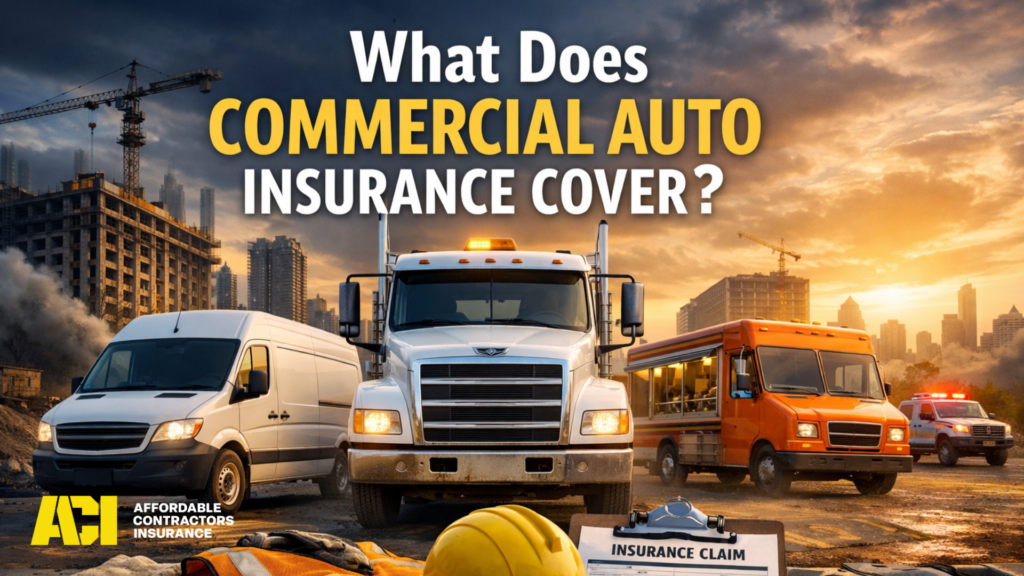
If your business relies on vehicles, commercial auto insurance isn’t just another policy, it’s operational protection.
Whether you run a contracting company, service business, or delivery operation, one accident can create significant financial exposure overnight. Commercial auto insurance protects your company from liability claims, vehicle damage, medical expenses, and costly downtime.
At Affordable Contractors Insurance (ACI), we structure policies around how your vehicles are actually used not generic templates that leave gaps.
What Is Commercial Auto Insurance?
Commercial auto insurance protects vehicles used for business purposes. That includes liability protection for bodily injury and property damage, coverage for repairs or replacement of your vehicles, and medical expense coverage after accidents.
For many contractors and trade businesses, liability limits of $1,000,000 or more are standard — especially when contracts, job sites, or municipalities require higher limits.
If a vehicle is generating revenue for your company, it should be reviewed under a commercial auto policy, not a personal auto policy.
In short, commercial auto insurance covers:
- Liability for injuries and property damage
- Repairs or replacement of your business vehicles
- Medical expenses after covered accidents
- Legal defense costs tied to auto-related claims
Types of Vehicles Covered
Commercial auto insurance can cover a wide range of vehicles depending on how your business operates. Pickup trucks used on job sites, service vans, box trucks, food trucks, and utility vehicles are all commonly insured under commercial policies.
Even personal vehicles may require commercial coverage if they are regularly used for business activities. The key factor is usage — not just ownership. If a vehicle supports your operations, it needs to be structured correctly under your policy.
Commonly insured vehicles include:
- Work trucks and pickup trucks
- Service vans and utility vehicles
- Box trucks and delivery vehicles
- Specialty vehicles such as food trucks
If you’re unsure whether your vehicle qualifies, you can:
Liability Coverage: The Foundation of Protection
Liability coverage is the core of a commercial auto policy. It protects your business if your driver causes injury to another person or damages someone else’s property.
This includes medical expenses for injured third parties, repairs to other vehicles, damage to buildings or equipment, and legal defense costs if your business is sued. Without adequate limits, your company’s assets could be exposed in a serious accident.
For contractors, liability coverage often needs to align with contract requirements. Many general contractors require higher limits and proper endorsements before allowing work to begin.
Liability coverage protects against:
- Bodily injury claims
- Property damage claims
- Lawsuits and legal defense expenses
- Contract-related insurance requirements
Physical Damage Coverage
Physical damage coverage protects your own vehicles.
Collision coverage pays for repairs or replacement if your vehicle is damaged in an accident, regardless of fault. Comprehensive coverage addresses non-collision events such as theft, vandalism, fire, hail, or falling objects.
With work trucks and commercial vehicles representing a significant investment, physical damage coverage protects your capital and keeps your operations moving after a loss.
Physical damage typically includes:
- Collision (accidents)
- Comprehensive (theft, fire, weather, vandalism)
- Repair or replacement of insured vehicles
Medical Payments Coverage
Medical payments coverage provides no-fault protection for medical expenses following an accident. It applies to drivers, passengers, and employees occupying the insured vehicle.
Covered expenses may include doctor visits, hospital stays, surgery, and ambulance services. This coverage helps resolve smaller injury claims quickly and reduces immediate financial pressure after an incident.
For businesses with employees regularly driving for work, this layer of protection is especially important.
Medical payments coverage can help pay for:
- Emergency room visits
- Hospital stays
- Surgery and treatment
- Ambulance services
Uninsured and Underinsured Motorist Coverage
Not every driver on the road carries adequate insurance. Uninsured and underinsured motorist coverage protects your business when the at-fault party either has no insurance or insufficient limits.
This coverage can help pay for medical expenses, lost wages, and certain damages that would otherwise go unpaid. In many states, this protection is required or strongly recommended.
UM/UIM coverage helps when:
- The other driver has no insurance
- The other driver’s limits are too low
- Medical expenses exceed the at-fault driver’s coverage
Hired and Non-Owned Auto Coverage
If employees use their personal vehicles for business tasks, or if your company rents vehicles temporarily, hired and non-owned auto coverage becomes critical.
This coverage protects your business from liability claims arising from accidents involving vehicles your company does not own. Without it, you may face uncovered liability exposure tied to employee driving activities.
This coverage applies to:
- Employee-owned vehicles used for work
- Short-term rental vehicles
- Temporary business vehicle use
Cargo Coverage
If your business transports tools, materials, or customer property, cargo coverage may be necessary. Standard commercial auto policies may not fully protect transported goods.
Cargo coverage can help protect against theft, accident-related damage, and losses during loading and unloading. For contractors carrying high-value tools or specialty materials, this exposure should be evaluated carefully.
Cargo coverage helps protect against:
- Theft during transit
- Damage from vehicle accidents
- Loss during loading and unloading
Rental Reimbursement Coverage
When a covered loss puts your vehicle in the repair shop, rental reimbursement coverage helps pay for a temporary replacement.
This coverage typically pays a daily rental amount for a specified number of days. It minimizes disruption to your operations and prevents unexpected out-of-pocket rental expenses.
Rental reimbursement helps:
- Maintain business continuity
- Reduce downtime
- Avoid unexpected rental costs
Roadside Assistance
Commercial roadside assistance can provide support for towing, flat tires, lockouts, fuel delivery, and jump-starts. While it may seem minor compared to liability protection, roadside coverage can prevent extended downtime and missed deadlines.
For contractors and service businesses working on tight schedules, fast recovery from vehicle breakdowns protects both revenue and reputation.
Roadside assistance may include:
- Towing services
- Tire changes
- Fuel delivery
- Lockout assistance
- Jump-start services
What Determines Your Coverage Needs?
Commercial auto insurance should be structured based on how your business operates.
Industry type, frequency of vehicle use, driver history, fleet size, and contractual requirements all influence the appropriate coverage structure. A construction contractor operating multiple trucks at job sites has a very different exposure than a consultant driving occasionally to meetings.
Key factors influencing coverage:
- Type of business and industry risk
- Vehicle usage patterns
- Driver experience and records
- Contractual insurance requirements
Final Thoughts
Commercial auto insurance isn’t just a regulatory requirement — it protects your vehicles, employees, contracts, and financial stability.
One uncovered accident can disrupt operations and strain your balance sheet. Structured correctly, commercial auto insurance acts as a safeguard that allows your business to operate confidently.
Commercial auto insurance ultimately protects:
- Your vehicles
- Your employees
- Your contracts
- Your company’s financial future
If your vehicles generate revenue, your coverage should reflect that reality.
We’ll review your vehicles, operations, and exposure to build a policy that supports how your business actually runs.