


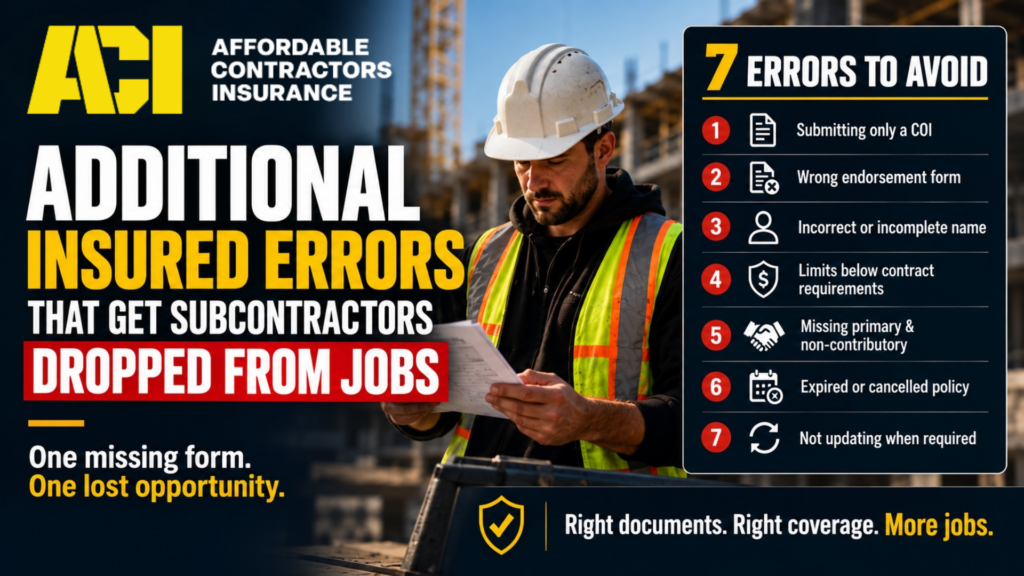
Subcontractors rarely lose work because of a claim. They lose it because a document failed a checklist.
A general contractor’s compliance team reviews the certificate, finds the additional insured endorsement missing, the wrong form attached, the entity name off by one word, or the limits short of what the contract requires. The sub gets flagged as non-compliant. Payment is held. On repeat offenses, they come off the bid list entirely — often without ever being told which line item caused it.
The frustrating part is that most of these failures have nothing to do with the quality of the subcontractor’s insurance program or their work. They’re paperwork and form-selection problems, and nearly all of them are fixable before a bid rather than after a rejection.
Here’s what additional insured status actually is, the specific errors that get subs disqualified, and how to make your submissions pass the first time.
What additional insured status actually does
An additional insured endorsement extends coverage under your liability policy to another party — typically the general contractor, the owner, a lender, or a property manager — for liability arising from your work.
The critical thing to understand is that this is direct coverage, not indemnity. Construction contracts generally use two separate risk-transfer mechanisms that work together but operate differently:
Contractual indemnity is a promise you make in the contract to reimburse the other party for certain losses. It’s a contractual obligation backed by your assets, with your policy’s contractual liability coverage responding to it.
Additional insured status makes that party an insured under your policy. When a claim arises, they tender it directly to your carrier and receive a defense and indemnity as an insured — without having to sue you or prove the indemnity provision applies.
That second mechanism is why general contractors care so intensely about the endorsement. A defense obligation that attaches directly to your carrier is worth vastly more to them than a promise from your company. It’s also why they verify it carefully, and why a deficiency is treated as a serious contract breach rather than a clerical issue.
Error 1: Submitting a certificate instead of an endorsement
This is the most common failure, and it stems from a widespread misunderstanding of what a certificate of insurance is.
The standard ACORD certificate carries an explicit disclaimer on its face: it is issued as a matter of information only, confers no rights on the certificate holder, and does not amend, extend, or alter the coverage afforded by the policies. That language isn’t fine print a carrier added defensively — it’s the form’s actual legal effect.
Which means a checked box next to “additional insured” on a certificate proves nothing. It reflects what someone at an agency typed. If no endorsement was actually issued on the policy, there is no additional insured coverage, and the certificate provides no recourse.
Sophisticated general contractors know this. Their compliance requirements increasingly demand the actual endorsement pages — the policy forms showing the additional insured grant — rather than a certificate alone. Subs who submit only a certificate get flagged immediately.
Fix: Request the endorsement forms from your agent and submit them alongside the certificate. If your agent can’t produce them, that’s a genuine problem worth resolving before you need them.
Error 2: The wrong endorsement form or edition date
This is where technical knowledge separates subs who pass review from subs who don’t. Additional insured endorsements are not interchangeable, and the differences are substantive.
| Form | What it does | When you need it |
| CG 20 10 | Additional insured for ongoing operations | Standard requirement during construction |
| CG 20 37 | Additional insured for completed operations | Required whenever the contract extends AI status past project completion |
| CG 20 33 / CG 20 38 | Blanket forms granting status automatically where a written contract requires it | Efficient for subs working with many upstream parties |
| CG 20 26 | Designated person or organization, not tied to “your work” | Sometimes required for broader grants |
| CG 20 01 | Primary and non-contributory other-insurance provision | Whenever the contract requires primary/non-contributory |
Two specific traps deserve attention.
Ongoing versus completed operations. The most widely used endorsement covers ongoing operations only — status ends when your work at the location is complete. If the contract requires additional insured status for completed operations and you’ve only attached the ongoing operations form, you are in breach of the insurance requirements, and the upstream party loses protection for exactly the claims most likely to surface later: construction defect allegations that appear months or years after the job closed.
Edition dates change coverage substantially. Endorsement editions from 2004 forward narrowed the trigger language, generally limiting coverage to liability caused, in whole or in part, by the named insured’s acts or omissions — meaningfully narrower than earlier “arising out of” language. Later editions added further limitations, including provisions restricting coverage to the extent permitted by law and stating that the coverage will not be broader than what the contract requires.
That last point produces a common surprise. A contract requiring $2 million in additional insured limits, paired with a current-edition endorsement, generally caps the additional insured’s protection at the contractually required amount rather than your full policy limit. Both sides frequently misunderstand this — and a GC who expects your full limits to be available may treat the discrepancy as non-compliance.
Fix: Know which forms and edition dates are on your policy. Send the contract’s insurance requirements to your agent before signing so the right endorsements can be issued or requested from the carrier.
Error 3: Missing primary and non-contributory status
Nearly every construction contract requires the subcontractor’s coverage to be primary and non-contributory. Many subs treat this as boilerplate. It isn’t — it changes which policy pays first.
Standard “other insurance” provisions cause policies covering the same loss to share on a pro rata basis. A primary and non-contributory requirement overrides that default: your policy pays first, in full, up to its limits, and your carrier won’t seek contribution from the upstream party’s own policy.
This generally requires a specific endorsement. It’s not automatic, and the checkbox on a certificate doesn’t create it. If the contract demands it and no endorsement exists, you’re non-compliant — and if a claim arrives, the GC’s carrier will discover it at the worst possible moment.
Fix: Confirm the primary and non-contributory endorsement is attached, and submit it with the rest of your package.
Error 4: No waiver of subrogation
A waiver of subrogation prevents your carrier from pursuing the upstream party to recover what it paid on a claim. Most construction contracts require one, and it protects the general contractor and owner from being sued by your own insurer after a loss.
Two things matter here. First, it requires an endorsement — carriers must agree to give up their recovery rights, and they don’t do so by default. Second, the waiver generally must be in place before the loss occurs. A waiver added after the fact typically doesn’t help.
Fix: Verify the waiver of subrogation endorsement is on the policy and applies to the parties the contract names.
Error 5: Scheduled forms with the wrong parties named
Additional insured endorsements come in scheduled and blanket varieties, and the difference causes a specific and very common rejection.
A scheduled endorsement lists specific named entities. If the GC isn’t on the schedule, they have no status — regardless of what the contract says or what the certificate shows. Every new project with a new upstream party requires the endorsement to be updated.
A blanket endorsement grants status automatically to any party you’ve agreed in a written contract to name. It’s far more practical for subs working across many projects — but it comes with a condition subs regularly violate: there must be a written contract executed before the loss, and generally before the work begins. Handshake agreements, verbal change orders, and work started ahead of a signed subcontract can leave the blanket grant with nothing to attach to.
Fix: If you’re on scheduled forms, build endorsement updates into your project onboarding process. If you’re on blanket forms, make sure contracts are actually signed before crews mobilize.
Error 6: Missing upper-tier parties
Contracts routinely require additional insured status for a list of entities: the general contractor, the owner, the construction manager, the lender, the property manager, a parent company, and sometimes “any party the contractor is required to name.”
Subs frequently name the GC and stop. The compliance reviewer checks the list against the contract, finds three entities missing, and rejects the submission.
Fix: Read the full list in the contract’s insurance article — it’s often longer than the parties you actually interact with — and confirm your endorsement reaches all of them.
Error 7: Exclusions that make the endorsement worthless
This is the most substantive error and the one that causes the most damage, because the paperwork can be perfect while the underlying coverage is hollow.
An additional insured grant can only extend coverage that actually exists. If your policy excludes the work you’re doing, the upstream party receives an endorsement that provides nothing when it matters.
The exclusions that most often gut a construction GL policy’s value:
Employee injury and action-over exclusions. This is the big one. Some policies exclude claims arising from injury to the named insured’s own employees — including the action-over scenario where your injured employee collects workers’ compensation, then sues the GC, who tenders to your policy as an additional insured. That is the single most common serious claim in construction, and this exclusion removes exactly it. Sophisticated GCs specifically screen for it.
Residential work exclusions. Common on contractor GL policies and fatal on residential projects.
Height, roofing, and elevation restrictions. Frequently found on policies for trades working above a certain height.
EIFS, subsidence, and earth movement exclusions. Trade-specific and often overlooked.
Subcontracted work limitations. Some policies restrict coverage when you use subs of your own, or require you to obtain specific coverage from them.
Fix: Ask your agent directly which exclusions apply to your policy and whether any of the work you routinely perform falls outside coverage. If an exclusion would defeat the additional insured grant your contracts require, that’s a reason to change coverage, not a detail to hope nobody checks.
Error 8: Umbrella that doesn’t follow form
Contracts often require total limits that only work if your umbrella responds — $1 million primary plus $4 million umbrella to reach a $5 million requirement.
The problem: the umbrella must actually extend additional insured status and follow the underlying grant. Some umbrella and excess policies limit or exclude additional insured coverage, or don’t follow form to the underlying endorsements. When that’s the case, the upstream party has $1 million of protection against a $5 million requirement, and the submission fails review.
Fix: Confirm in writing that your umbrella follows form for additional insured status.
Error 9: Administrative details that fail on the first pass
These are trivial to fix and account for an outsized share of rejections:
- Entity name mismatches. “ABC Construction” instead of “ABC Construction Group, LLC.” Compliance software matches exactly, and near-misses get flagged.
- Wrong project name, number, or address on the certificate.
- Expired certificates mid-project. Renewal certificates need to be issued proactively, not when someone finally notices.
- Limits below contract requirements, including per-occurrence, aggregate, products-completed operations aggregate, and umbrella.
- Carrier eligibility problems. Many contracts require admitted carriers or a minimum financial strength rating. If your coverage is written on non-admitted surplus lines paper — common and entirely legitimate for hard-to-place risks — some contracts will reject it, and that needs to be identified before you bid rather than after you’ve won.
- Certificate holder confused with additional insured. They’re different things; being listed as a certificate holder grants no coverage at all.
What this actually costs a subcontractor
The consequences escalate predictably.
First submission gets rejected and work can’t start, which delays mobilization. Progress payments get held while compliance is pending — many GCs won’t release funds to a non-compliant sub, which becomes a cash flow problem quickly. Repeat non-compliance results in removal from the bid list, and because most GCs manage this through compliance software rather than relationships, the removal is often automatic and unexplained.
Then there’s the worst case: a claim arrives, the endorsement everyone assumed existed doesn’t, and the general contractor’s carrier pays a loss it expected to tender to you. That produces a breach of contract claim against you for failing to procure the required insurance — and the damages are the amount your coverage should have provided. That exposure sits outside your policy, because it’s a contractual failure rather than a covered occurrence.
Getting it right before the bid
Send insurance requirements to your agent before bidding. Not before signing — before bidding. If the requirements exceed what your program can deliver, that’s a pricing and negotiation issue, not a discovery to make after you’ve won the work.
Ask for the endorsements, not just a certificate, and keep current copies on file for every active project.
Know your forms and edition dates, and specifically whether you carry ongoing operations only or ongoing plus completed operations.
Move to blanket endorsements where practical — they eliminate the most common scheduling error — and make sure contracts are executed before work begins.
Confirm primary and non-contributory status and waiver of subrogation are endorsed, not just represented.
Screen your own policy for exclusions that would defeat the grant, especially any employee injury or action-over exclusion.
Verify your umbrella follows form for additional insured status.
Build a compliance calendar tracking renewal dates and project-specific requirements, and issue updated certificates before they lapse rather than after.
Use your exact legal entity name on everything.
Frequently asked questions
What is an additional insured endorsement? It’s an endorsement extending coverage under your liability policy to another party — typically a general contractor, owner, or lender — for liability arising from your work. Unlike contractual indemnity, it makes them an insured under your policy, allowing them to tender a claim directly to your carrier for defense and indemnity.
Is a certificate of insurance the same as an additional insured endorsement? No. A certificate is informational and expressly confers no rights or coverage. Only the endorsement issued on the policy creates additional insured status. A checked box on a certificate without a corresponding endorsement provides nothing.
What’s the difference between CG 20 10 and CG 20 37? CG 20 10 provides additional insured status for ongoing operations, ending when your work at the location is complete. CG 20 37 extends status to completed operations — claims arising after the work is finished. Contracts frequently require both, and carrying only the first is a common compliance failure.
What does primary and non-contributory mean? It means your policy pays first and in full, without seeking contribution from the upstream party’s own insurance. Standard other-insurance provisions would otherwise cause policies to share pro rata. It generally requires a specific endorsement and is not automatic.
Why do general contractors require a waiver of subrogation? It prevents your insurer from pursuing the general contractor or owner to recover claim payments. It requires a carrier endorsement and generally must be in place before a loss to be effective.
What’s the difference between scheduled and blanket additional insured endorsements? A scheduled endorsement names specific entities and must be updated for each new party. A blanket endorsement automatically grants status to any party you’ve agreed in a written contract to name, but generally requires a written contract executed before the loss and before work begins.
Why did the general contractor reject my certificate of insurance? Common reasons include a missing endorsement, the wrong form or edition, missing primary and non-contributory or waiver of subrogation status, limits below contract requirements, missing upper-tier parties, an entity name mismatch, an expired certificate, or a carrier that doesn’t meet the contract’s admitted-status or rating requirements.
Can I be sued if I don’t provide the additional insured coverage my contract requires? Yes. Failing to procure required insurance is generally a breach of contract, and damages can equal the coverage that should have been provided. Because it’s a contractual failure rather than a covered occurrence, that exposure typically falls outside your own policy.
Get the paperwork right before it costs you the job
Additional insured compliance is unusual among contractor risks in that it’s almost entirely administrative. There’s no weather to predict, no accident to prevent — just a set of forms that either match the contract or don’t. Yet it removes competent subcontractors from bid lists regularly, holds up payments on completed work, and occasionally creates uninsured contractual liability that dwarfs the value of the project.
The subs who never have this problem aren’t lucky. They send insurance requirements to their agent before bidding, carry blanket endorsements, keep endorsement copies on file, and know what their policy excludes.
If you’re not certain which additional insured forms are on your policy, whether your umbrella follows form, or whether an exclusion would undercut the coverage your contracts require, that review is worth doing before your next bid.
Affordable Contractors Insurance works with subcontractors and specialty trades nationwide on general liability, additional insured and contractual requirements, umbrella and excess coverage, and hard-to-place E&S risks that standard carriers decline. Send us your contract’s insurance requirements and we’ll tell you exactly where your current program falls short.
This article is general information, not legal advice. Endorsement forms, edition dates, and state law governing insurance requirements vary. Review your specific policy and contract with your agent and legal counsel.