


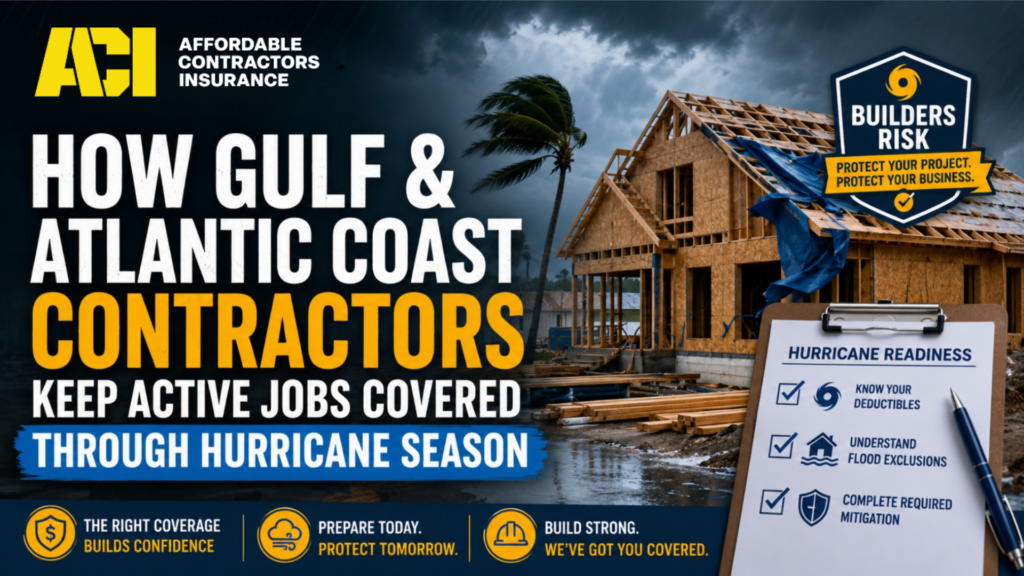
If a hurricane damages a project you’re building, the coverage that pays to rebuild it is builders risk insurance with windstorm coverage — not your general liability policy. Whether that claim actually pays comes down to three things most contractors never check until it’s too late. The storm deductible on the policy, the flood exclusion, and the mitigation steps the policy requires you to take before the storm arrives.
That’s the short version. The rest of this guide explains how each piece works, where contractors along the Gulf and Atlantic coasts get caught out, and what you can do right now to make sure a named storm doesn’t turn an active job into an uninsured loss.
What hurricane season actually means for a jobsite
The Atlantic hurricane season runs from June 1 through November 30, but the risk isn’t spread evenly across those six months. The climatological peak falls in mid-September, and the heart of the season — roughly mid-August through late October — is when the Gulf of Mexico and the Atlantic coast see the most activity. For a contractor, that means the back half of Q3 is the window when an active project is most exposed.
Geographically, the highest-risk states are the ones with coastline on warm water: Texas, Louisiana, Mississippi, Alabama, and Florida along the Gulf, and Georgia, the Carolinas, and up the Eastern Seaboard on the Atlantic side. But inland contractors shouldn’t tune out. Storms weaken as they move inland, yet they still carry damaging wind and enormous rainfall well past the coast — a project in central Georgia or the Carolina Piedmont can absorb serious wind and water damage from a system that made landfall a day earlier.
The exposure that matters most is a project that is under construction but not yet weather-tight. A finished, closed-in building has a permanent property policy and a completed envelope designed to shed weather. A framed shell, an open roof deck, or a structure mid-dry-in has neither. That in-between state is exactly where builders risk earns its keep.
Why general liability won’t rebuild a storm-damaged job
This is the most common and most expensive misunderstanding in construction insurance, so it’s worth being precise.
General liability (GL) covers third-party bodily injury and property damage — harm your operations cause to other people or to property that isn’t yours. If a hurricane sends your stacked lumber through a neighbor’s window, the resulting damage to that neighbor’s home is a general liability question.
Damage to your own work in progress is not. When wind strips the sheathing off the house you’re framing, or rain floods the interior of a structure you haven’t closed in, that’s damage to the project itself — your work product. GL was never built to cover it, and it won’t.
The coverage designed for that exposure is builders risk, also called course of construction insurance.
Builders risk: the coverage that protects the job itself
Builders risk is a property policy for a structure while it’s being built. It insures the building under construction, the materials and supplies staged to go into it, and — depending on how it’s written — equipment on site, materials in transit, and materials stored off site. Coverage generally begins when construction starts and ends at completion, occupancy, or a defined milestone, at which point a permanent property policy should take over.
When it comes to hurricanes, three details determine whether the policy actually responds. Contractors who understand these three go into the season protected. Contractors who don’t tend to find out the hard way.
1. The storm deductible is not a flat number
In most parts of the country, a policy has a single flat deductible. Builders risk and commercial property policies typically apply a separate, higher deductible for named storms, hurricanes, and windstorms in coastal and hurricane-prone regions. Instead of a fixed dollar amount, insurers usually calculate this deductible as a percentage of the property’s insured value.
That distinction has real teeth. A percentage deductible on a large project can translate into a significant out-of-pocket cost before coverage pays a dollar.
| Deductible type | How it’s calculated | When it applies |
| Standard / all-other-perils | Flat dollar amount | Most non-wind losses (fire, theft, non-named-storm events) |
| Windstorm or wind/hail | Percentage of insured value | Wind and hail damage generally |
| Named-storm or hurricane | Percentage of insured value | Triggered when a storm is officially named or classified as a hurricane |
Two policies with the same premium can leave you in very different positions after a storm, depending purely on how the wind deductible is structured. Before the season, confirm which deductible applies to a hurricane loss and calculate the actual dollar figure on each active project so there are no surprises.
2. Flood is excluded — and “flood” is broader than you think
Standard builders risk and property policies exclude flood, and this is where hurricane claims most often fall apart. The nuance that separates a paid claim from a denied one is how the water got in.
- Wind-driven rain that enters through an opening the storm created — for example, rain pouring in after wind tore off part of the roof — is generally treated as wind damage and is typically covered.
- Rising water, storm surge, and flooding — water that comes up from the ground or in from the ocean — is excluded and requires separate flood coverage.
For a coastal project, storm surge is often the most destructive part of a hurricane, and it is precisely the part a standard policy won’t touch. If your project is located in a flood-prone area, you must purchase flood coverage separately through the National Flood Insurance Program (NFIP) or a private flood insurance provider. Builders risk insurance typically does not include flood coverage by default.
3. The policy expects you to protect the work
Builders risk and installation policies commonly include a protective safeguards or reasonable-care requirement. When a storm is in the forecast, you should take reasonable steps to protect the jobsite. Secure or remove loose materials, board up or cover openings, tie down equipment, and tarp exposed structures to help minimize potential damage.
If a carrier concludes that you left a job needlessly exposed when you had time and warning to protect it, they can reduce or deny the claim. Coverage assumes you did your part. With a named storm, you often have days of advance notice — which means the “we didn’t have time” defense rarely holds up.
Who needs this coverage
Anyone with money in the ground on an active coastal or hurricane-exposed project has exposure, but responsibility depends on the contract.
On many projects, the general contractor or the property owner carries the builders risk policy for the whole job. That doesn’t fully protect the subcontractors. Subcontractors can still lose their own tools, equipment, and uninstalled materials during severe weather. Your contract determines who assumes the risk of loss. Making it essential to understand who is financially responsible if a storm damages the project. Roofers and framers face some of the highest risk because they often leave structures exposed while working, increasing the potential for weather-related damage.
Before storm season begins, review your contract’s insurance and risk-of-loss provisions. Confirm, in writing who carries the builders risk policy, what it covers, and whether you’re listed as an insured or additional insured. Never assume another party’s policy automatically protects your work or property—making that assumption can lead to costly uncovered losses.
Common mistakes contractors make before hurricane season
A few patterns show up again and again in denied or underpaid hurricane claims:
- Insuring to contract price instead of rebuild cost. After a total loss, you rebuild at current material and labor prices. If your limit was set to the original number and prices have risen, you’re underinsured on the rebuild.
- Not knowing the storm deductible in dollars. Knowing it’s “2%” isn’t the same as knowing it’s tens of thousands of dollars on a specific job.
- Assuming flood is covered. It almost never is under builders risk, and storm surge is flood.
- Letting coverage lapse at the wrong milestone. If builders risk ends at “substantial completion” but the permanent property policy hasn’t started, a storm during that gap is uninsured.
- Skipping documentation. No time-stamped photos of the work in place and the protective steps taken means a weaker claim.
- Ignoring the mitigation clause. Failing to board up or tarp when a named storm is days out can void an otherwise valid claim.
Cost considerations: protecting the job without overpaying
Coastal builders risk isn’t cheap, but there are legitimate ways to manage the cost without gutting your protection.
The deductible is the biggest lever. A higher windstorm deductible lowers premium, but only take on as much as you can genuinely absorb on your largest active project — the savings aren’t worth it if a single storm would sink you. Accurate insured values matter too: over-insuring wastes premium, while under-insuring can trigger a coinsurance penalty that reduces your payout. Shortening the coverage term to the realistic construction window, bundling multiple projects under a blanket or reporting-form policy, and demonstrating strong jobsite risk management can all help. And because much coastal and catastrophe-exposed builders risk is written in the excess and surplus (E&S) market, working with a broker who has access to those markets often makes the difference between a workable quote and no quote at all.
A realistic scenario
Consider a framing contractor with a townhome project on the Gulf Coast, framed and partially sheathed, roof deck open, when a named storm forms in the Gulf with a projected landfall three days out.
The contractor who is protected has builders risk with windstorm coverage and knows the hurricane deductible in dollars. Over those three days, the crew secures loose materials, ties down equipment, covers openings where possible, and photographs everything. When wind damages the exposed structure, the claim is documented, the mitigation is provable, and the policy responds. Minus the known deductible.
The contractor who isn’t protected assumed the GC’s policy covered everything. They never confirmed it, took no protective steps, and has no documentation. Same storm, same damage — but the loss lands on the business instead of the policy. The difference wasn’t luck. It was preparation and the right coverage.
How to get ready before the peak
Well before mid-September, work through this short list on every active coastal or hurricane-exposed job:
- Confirm that builders risk with windstorm coverage is in place and who carries it.
- Calculate the actual dollar amount of the hurricane/named-storm deductible per project.
- Verify whether flood coverage is needed and whether it exists.
- Check that insured limits reflect current rebuild cost, not just contract price.
- Confirm there’s no coverage gap between builders risk ending and permanent property coverage beginning.
- Build a storm-prep and documentation routine into your jobsite procedures now, not when a storm is named.
Frequently asked questions
Does builders risk cover hurricane damage? Yes, when it’s written with windstorm coverage — which typically carries a separate percentage-based deductible for named storms or hurricanes. Wind damage to the structure and materials is usually covered; flood and storm surge are excluded and require separate flood coverage.
Does general liability cover storm damage to my construction project? No. General liability covers third-party injury and property damage. Storm damage to your own work in progress is covered by builders risk, not GL.
Is storm surge covered under my builders risk policy? No. Storm surge is treated as flood, which is excluded from standard builders risk and property policies. Coverage for surge and rising water requires a separate flood policy through the NFIP or a private/surplus lines market.
What is a hurricane or named-storm deductible? It’s a separate deductible that applies specifically to hurricane or named-storm losses, usually calculated as a percentage of the insured value rather than a flat dollar amount. It’s generally higher than the policy’s standard deductible and is common in coastal regions.
Who is responsible for hurricane damage on a construction site — the GC or the subcontractor? It depends on the contract’s risk-of-loss provisions and who carries the builders risk policy. Often the general contractor or owner insures the project, but subcontractors can still be exposed for their own equipment and un-installed materials. Confirm in writing what covers you before the season.
Can I still get builders risk for a coastal project? Often yes, though coastal and catastrophe-exposed builders risk is frequently written in the excess and surplus (E&S) market. A broker with real E&S access can usually place coverage that standard carriers decline.
Protect the work before the storm has a name
The projects you’re building right now represent money you’ve already spent — labor, materials, and time you can’t recover if a storm takes them. General liability won’t rebuild them, and the details that decide whether a hurricane claim pays are the ones easiest to overlook until it’s too late: the deductible, the flood exclusion, and the mitigation clause.
If you have active jobs anywhere along the Gulf or Atlantic coast, the time to review your builders risk coverage is before a storm is named — not after. Affordable Contractors Insurance specializes in contractor coverage, including builders risk and hard-to-place E&S risks for projects standard carriers won’t touch. If you’re not certain your active jobs are truly protected for this season, request a coverage review and we’ll walk through exactly where you stand.