


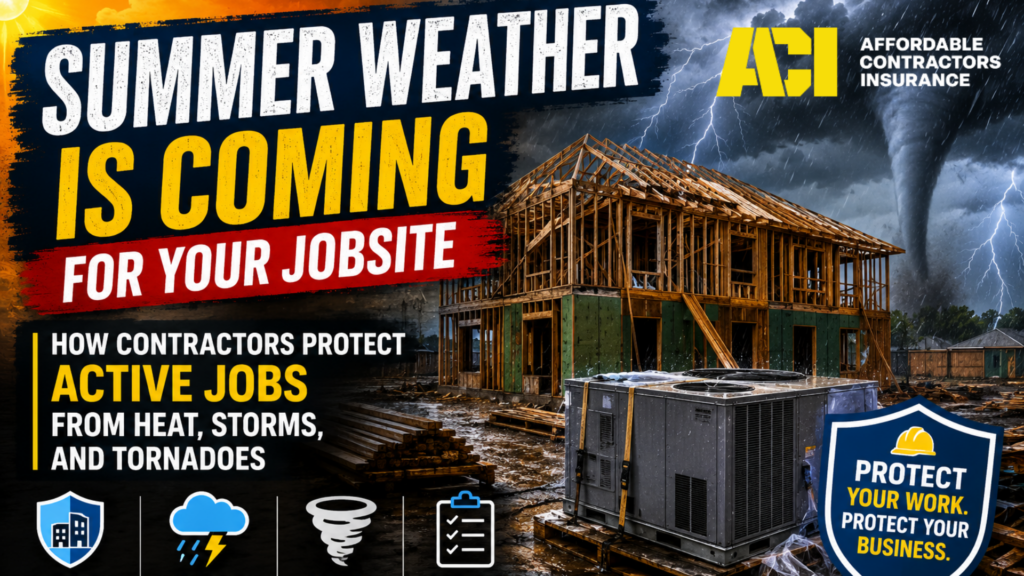
Every year, from roughly June through September, the same thing happens across the country. Crews are busy, project calendars are packed, and the weather turns violent — Arizona monsoons roll in, Tornado Alley lights up, and open structures in rainy regions take on water they were never meant to see. And every year, contractors discover the hard way that the coverage protecting their finished work often does nothing for the job that’s half-built and sitting exposed under a storm cloud.
If you run active projects this time of year, the risk isn’t theoretical. A single microburst, hailstorm, or overnight downpour can turn a profitable job into a total rebuild — with the loss landing squarely on whoever “owns” the risk at the moment the weather hits. This guide breaks down the seasonal threats by region, the coverage gaps that catch contractors off guard, and the concrete steps that keep an active job protected.
The gap most contractors don’t see until it’s too late
Here’s the problem in one sentence: your general liability policy does not pay to rebuild your own work when a storm destroys it.
General liability responds to third-party bodily injury and property damage — someone else’s person or property. When wind peels the sheathing off a house you’re framing, or rain floods the interior of a structure you haven’t dried in yet, that’s damage to your work in progress. GL was never designed to cover it.
The coverage that actually protects a job mid-construction is builders risk (also called course of construction insurance). It insures the structure, the materials, and often the equipment on site while the project is being built — right up until it’s completed and handed off. If you’re running summer projects without it, or with limits that don’t match the true value of the work in place, you’re carrying the weather risk yourself.
That distinction — finished work versus work in progress — is the single most important thing to understand before the next storm season. Everything below builds on it.
Region 1: Arizona and the Desert Southwest — heat, haboobs, and the monsoon
Arizona’s summer is a two-part threat: relentless extreme heat, followed by the monsoon that runs from mid-June into September.
The heat pain points. Triple-digit temperatures don’t just slow crews down — they create liability. Adhesives and sealants cure wrong. Materials warp and expand. Rooftop work becomes a heat-illness exposure for your crew. And for HVAC contractors specifically, extreme ambient heat during installation and start-up gets blamed when a system underperforms later, even when the real cause was a manufacturer defect or a design issue. The installer is the easiest party to point at.
The monsoon pain points. When the monsoon hits, it hits fast: microbursts with 60–80 mph downdrafts, dust storms (haboobs) that bury materials and equipment, and flash flooding that can sweep a graded site or fill a foundation overnight. A jobsite that was bone-dry at 4 p.m. can be underwater by 7.
HVAC-specific exposure. For mechanical contractors, the highest-risk moment is the window between delivery and installation complete. Rooftop units staged on a roof, condensers sitting in a side yard, refrigerant line sets and ductwork waiting to be installed — none of that is “your finished work” yet, and none of it is covered by GL. If a haboob or microburst damages equipment before it’s installed and accepted, you need an installation floater (or builders risk with equipment coverage) to make yourself whole. Without it, you’re often eating the replacement cost and the schedule delay.
What protects the job here: builders risk / course of construction, an installation floater for staged equipment, and contractor’s equipment (inland marine) coverage for your tools and rented machinery.
Region 2: Tornado country — Oklahoma, Texas, Kentucky, and Illinois
Traditional “Tornado Alley” through Oklahoma and Texas remains active, but the risk has broadened east and north — into Kentucky, Illinois, and the broader Midwest and Mid-South. For contractors, this is arguably the most destructive seasonal threat, because a tornado doesn’t damage a job. It erases it.
The pain points. A framed but not-yet-dried-in structure is essentially a kite. High straight-line winds and tornadoes can level partial framing, scatter lumber and materials across neighboring properties, and turn your staged supplies into airborne debris. Two distinct exposures follow from that:
- Loss of the work in place. Everything you’ve built and paid for up to that moment — gone. This is a builders risk claim, and the limit needs to reflect the completed value of the project, not what’s standing today, because you’ll be rebuilding from the ground up.
- Debris and third-party damage. When your materials become projectiles and damage a neighbor’s home or vehicle, that’s a general liability question. Both coverages matter in a wind event, and they respond to different parts of the loss.
The deductible trap. In wind-prone regions, builders risk policies frequently carry a named-storm or wind/hail deductible expressed as a percentage of the insured value rather than a flat dollar amount. On a large project, that percentage can translate into a five- or six-figure out-of-pocket cost before coverage even kicks in. Knowing your deductible structure before the storm — not while you’re filing the claim — is critical.
What protects the job here: builders risk written with wind coverage and a clearly understood deductible, plus general liability for third-party debris damage.
Region 3: Open structures and roof damage in rainy regions
Across the Southeast, Ohio Valley, and anywhere summer brings heavy rain, the defining exposure this time of year is water intrusion into an open structure. This hits roofers, framers, and general contractors hardest — anyone with a project that’s framed but not yet weather-tight.
The pain points. An open roof deck, a torn-off roof mid-replacement, or a structure that’s dried-in on paper but not sealed in practice is a water claim waiting to happen. A single overnight thunderstorm can soak framing, ruin subfloors and insulation, destroy freshly installed interior finishes, and seed a mold problem that shows up weeks later and costs far more than the original water damage. For roofing contractors, the worst-case scenario is a tear-off left exposed when an unforecasted cell moves through.
The “reasonable care” catch. Many builders risk and installation policies include a protective-safeguards or mitigation requirement — you’re expected to take reasonable steps to protect the work, such as tarping an exposed roof or covering openings when weather threatens. If a carrier determines you left a structure needlessly exposed, they can reduce or deny the claim. Coverage assumes you did your part.
What protects the job here: builders risk that includes water-damage-from-weather coverage, attention to any tarping/mitigation warranties in your policy, and — for larger projects — soft costs / delay in completion coverage to offset the lost time and extended costs when water pushes your schedule.
The four coverages that actually protect an active job
Regardless of region, these are the pieces that keep a work-in-progress protected. Most contractors carry the last one and assume it covers everything. It doesn’t.
- Builders Risk (Course of Construction). The backbone. Insures the structure, materials, and often on-site equipment against covered perils — including wind, hail, and (when written correctly) weather-driven water damage — until the project is complete. Match the limit to the completed value, not today’s progress.
- Installation Floater. Purpose-built for trades installing equipment and materials — HVAC, electrical, plumbing. Covers your product from the moment it leaves your shop or arrives on site through the moment installation is complete and accepted. This is the coverage that protects staged HVAC units and line sets before they’re in.
- Contractor’s Equipment / Inland Marine. Covers your owned and rented tools, machinery, and equipment against theft and damage — including when a storm flips a scissor lift or buries a compressor.
- General Liability. Essential, but know its edge: it covers third-party bodily injury and property damage — the neighbor’s house, a passerby’s car, debris that travels off site. It does not rebuild your own damaged work. That’s what the three coverages above are for.
The fine print that leaves contractors exposed
Even contractors who carry builders risk get surprised by the exclusions and conditions buried in the policy. Before storm season, check for these:
- Percentage wind/hail and named-storm deductibles — often far larger than a flat deductible in catastrophe-prone regions.
- Flood exclusion — flood is almost always excluded from standard builders risk and requires separate coverage. Flash flooding on a graded site is a real exposure in the Southwest and Gulf regions.
- Water-damage limitations — confirm that weather-driven water intrusion into an open structure is actually covered, not carved out.
- Mitigation / protective-safeguard warranties — the tarping and site-protection duties that, if ignored, can void a claim.
- Coverage ending at “substantial completion” or occupancy — the policy may stop protecting you sooner than you think, leaving a gap before your permanent property policy takes over.
- Limits set to contract price, not rebuild cost — after a total loss, you’re rebuilding at current material and labor prices, which may exceed your original number.
Best practices: how to protect your current jobs this season
Coverage is the safety net. Good jobsite discipline is what keeps you from needing it. Before and during storm season:
Prep the site when weather threatens. Tarp open roofs and structures, secure or remove loose materials, tie down or stage equipment out of wind exposure, and clear anything that can become a projectile. This isn’t just good practice — it’s often a policy requirement.
Document before the storm. Photo and video the jobsite regularly, especially ahead of a forecasted event. Time-stamped documentation of the work in place and the protective steps you took is your strongest asset in a claim.
Right-size your limits. Review each active project’s builders risk limit against its completed value and current rebuild costs — not the value of what’s standing today.
Know your deductibles cold. Especially the wind/hail and named-storm percentages. Budget for them as a real cost of running summer jobs in a catastrophe-prone area.
Report early. The moment damage occurs, notify your agent and start the claim. Delays give carriers room to question causation and mitigation.
Frequently asked questions
Does builders risk cover wind and hail damage? Most builders risk policies cover wind and hail, but in storm-prone regions they often apply a percentage-based deductible for those perils — sometimes a named-storm deductible calculated on the insured value. Confirm both that the peril is covered and how the deductible is structured.
Who is responsible for weather damage on a construction site? It depends on the contract and who holds the builders risk policy. In many projects the general contractor or owner carries course-of-construction coverage, but subcontractors can still be exposed for their own materials and installed work. Read your contract’s risk-of-loss and insurance provisions carefully.
Is my HVAC equipment covered before it’s installed? Not by general liability, and not always by a project’s builders risk policy. Equipment staged on site but not yet installed and accepted is best protected by an installation floater or builders risk written to include on-site equipment. Without it, weather damage to un-installed units is typically your cost.
Does general liability cover storm damage to my project? No. General liability covers third-party bodily injury and property damage. Damage from a storm to your own work in progress is covered by builders risk, an installation floater, or contractor’s equipment coverage — not GL.
What deductible applies during a tornado or named storm? Many policies apply a special windstorm, hail, or named-storm deductible in high-risk areas, often expressed as a percentage of insured value rather than a flat amount. On a large project this can be substantial, so confirm the exact figure before the season, not during a claim.
Protect the work you’ve already put in the ground
The jobs you’re running right now represent real money already spent — labor, materials, and time you can’t get back. Summer weather doesn’t care what stage they’re at, and the wrong coverage gaps can turn a storm into a business-threatening loss.
Affordable Contractors Insurance specializes in exactly these risks — builders risk, installation coverage, general liability, and hard-to-place E&S exposures for HVAC, roofing, framing, and general contractors across the country. If you’re not sure whether your active jobs are truly covered for this season’s heat, wind, and water, now is the time to find out — not after the next storm.
Get a coverage review or a quote from Affordable Contractors Insurance before the next storm rolls in.