
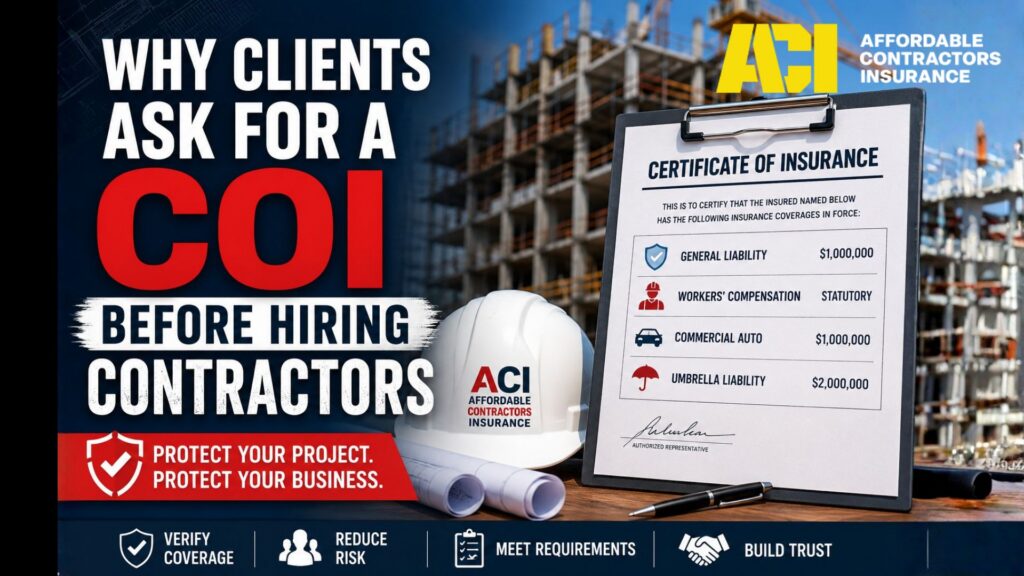
For many contractors, being asked to provide a Certificate of Insurance (COI) is simply part of doing business. Whether you’re bidding a commercial project, signing a subcontract agreement, working with a property manager, or performing work for a municipality, chances are you’ll be asked to provide proof of insurance before work begins.
Yet many contractors don’t fully understand why clients request a COI—or what project owners, general contractors, property managers, and commercial clients are actually looking for when they review one.
We regularly work with contractors who are ready to start a project only to discover that their certificate has been rejected, their coverage doesn’t meet contract requirements, or they are missing a required endorsement. These situations can delay project starts, strain client relationships, and in some cases cost contractors the job entirely.
Understanding how Certificates of Insurance work can help you avoid these issues, strengthen client confidence, and position your business for larger and more profitable opportunities.
What Is a Certificate of Insurance (COI)?
A Certificate of Insurance, commonly referred to as a COI, is a document that summarizes the insurance policies carried by your business.
It serves as proof that your company maintains active insurance coverage and provides a snapshot of key information about those policies. A typical COI includes your business name, insurance carrier information, policy numbers, coverage types, policy limits, effective dates, and expiration dates.
Most certificates are issued using ACORD forms, which provide a standardized format recognized throughout the insurance industry.
While a COI is not the actual insurance policy, it serves as evidence that coverage exists and allows clients to quickly verify that a contractor meets their insurance requirements.
For many contractors, the COI becomes one of the most important documents provided during the bidding and onboarding process.
Why Do Clients Require a COI Before Work Begins?
The simple answer is risk.
Construction projects create significant liability exposure for everyone involved. Property owners, developers, general contractors, municipalities, and property managers all face potential financial consequences if something goes wrong on a project.
Before allowing a contractor onto a job site, clients want assurance that appropriate insurance coverage is in place.
For example, if a contractor accidentally damages a client’s property, the client wants confidence that a General Liability policy exists to respond to the claim.
If an employee is injured on the job, the project owner wants assurance that Workers’ Compensation coverage is in place.
If a company vehicle causes an accident while performing work, the client wants to know there is Commercial Auto coverage available.
The COI serves as a quick verification tool that confirms these protections exist before work begins.
The Hidden Reason Clients Ask for COIs
While insurance verification is important, many clients are evaluating something else entirely: professionalism.
Contractors who maintain proper insurance programs tend to be viewed as more established, more organized, and lower-risk than contractors who do not.
When a contractor can quickly provide a valid COI that satisfies project requirements, it sends a message that they operate a professional business and understand the expectations of commercial clients.
On the other hand, contractors who struggle to provide certificates, submit outdated documentation, or repeatedly fail to satisfy insurance requirements can create concerns before a project even starts.
In many ways, your insurance documentation becomes part of your first impression.
What Clients Are Actually Looking For When They Review a COI
One of the biggest misconceptions contractors have is assuming that clients simply want proof that insurance exists.
In reality, most commercial clients are reviewing certificates to determine whether specific contractual insurance requirements have been satisfied.
The review process often goes far beyond checking whether a policy is active.
Clients may be verifying:
General Liability limits, Workers’ Compensation coverage, Commercial Auto coverage, Umbrella Liability limits, Additional Insured requirements, Waiver of Subrogation endorsements, and Primary & Non-Contributory wording.
In many cases, simply having insurance is not enough. The policy must meet the exact requirements outlined in the contract.
This is one of the most common reasons certificates get rejected.
General Liability Insurance and COI Requirements
General Liability insurance is one of the most commonly requested coverages shown on a COI.
This coverage helps protect contractors against claims involving bodily injury, property damage, and certain personal or advertising injury claims arising from their operations.
Many commercial contracts require minimum General Liability limits before work can begin. While some smaller projects may require a standard $1 million occurrence limit, larger commercial projects often require significantly higher limits, especially when combined with Umbrella coverage.
Clients frequently review General Liability coverage first because it serves as the foundation of a contractor’s insurance program.
Without adequate liability limits, contractors may find themselves unable to qualify for larger projects or commercial opportunities.
Workers’ Compensation Coverage
Workers’ Compensation insurance is another critical coverage that clients routinely verify.
Construction remains one of the highest-risk industries for workplace injuries. Clients want assurance that contractors maintain Workers’ Compensation coverage for their employees so that injuries can be handled through the contractor’s policy rather than creating potential exposure for project owners or general contractors.
Maintaining Workers’ Compensation coverage demonstrates a commitment to employee safety while helping contractors satisfy contractual and regulatory requirements.
For growing contractors, Workers’ Compensation also plays an important role in maintaining a favorable Experience Modification Rate (EMR), which can impact competitiveness when bidding certain projects.
Commercial Auto Insurance Requirements
Many contractors rely on trucks, vans, trailers, and other vehicles to transport employees, tools, and materials between job sites.
As a result, Commercial Auto coverage is frequently required by commercial clients and general contractors.
Commercial Auto insurance helps protect against liability claims arising from vehicle accidents involving company-owned vehicles. Depending on the project, clients may require specific liability limits before approving a contractor to begin work.
Contractors often overlook Commercial Auto requirements until a certificate request arrives, making it important to review contracts carefully before mobilizing crews.
Understanding Additional Insured Requirements
One of the most common reasons contractors encounter issues with COIs is Additional Insured requirements.
Many contracts require project owners, property managers, developers, or general contractors to be added as Additional Insureds under the contractor’s General Liability policy.
This endorsement provides certain protections to those parties in connection with the contractor’s operations and is often mandatory for commercial projects.
Importantly, simply listing someone on a certificate does not automatically make them an Additional Insured. The endorsement must actually exist within the policy.
This is a common misunderstanding and one of the leading reasons certificates are rejected.
Waiver of Subrogation and Primary & Non-Contributory Requirements
As contractors move into larger commercial projects, they often encounter more sophisticated insurance requirements.
Two of the most common are Waiver of Subrogation and Primary & Non-Contributory wording.
A Waiver of Subrogation limits an insurance carrier’s ability to seek reimbursement from certain parties after paying a claim.
Primary & Non-Contributory wording establishes that the contractor’s policy will respond first before another party’s insurance contributes to a claim.
These requirements are extremely common in commercial construction contracts and frequently appear alongside Additional Insured requirements.
Common Reasons COIs Get Rejected
At ACI, we regularly see contractors surprised when a certificate is rejected.
Some of the most common reasons include:
- Missing Additional Insured endorsements
- Insufficient liability limits
- Expired policies
- Incorrect business names
- Missing Workers’ Compensation coverage
- Missing Waiver of Subrogation wording
- Failure to satisfy contractual insurance requirements
- Incorrect certificate holder information
- Missing Umbrella Liability coverage
Most certificate issues can be avoided through a careful review of both the insurance policy and the contract requirements before the certificate is issued.
How COI Issues Delay Projects
Many contractors underestimate how much project scheduling depends on insurance compliance.
We’ve seen situations where crews were ready to mobilize, materials had already been ordered, and subcontractors had been scheduled, only for the project to be delayed because insurance requirements were not satisfied.
In competitive construction environments, these delays can create ripple effects that impact profitability, scheduling, client relationships, and future opportunities.
A rejected certificate may seem like a small administrative issue, but it can quickly become a costly operational problem.
Why COIs Become More Important as Contractors Grow
As contractors move from smaller residential jobs into larger commercial projects, insurance requirements become significantly more complex.
Projects involving apartment developments, office buildings, schools, municipalities, industrial facilities, healthcare facilities, and large-scale commercial construction often have strict insurance requirements that exceed standard policies.
Many contractors discover that the insurance program that worked when they were generating a few hundred thousand dollars in annual revenue is no longer sufficient when pursuing multi-million-dollar projects.
Growth often requires higher limits, additional endorsements, broader coverage, and a more strategic approach to risk management.
Need Help Reviewing Your COI Requirements?
Many contractors don’t discover insurance gaps until a certificate gets rejected or a project gets delayed.
At Affordable Contractors Insurance, we help contractors review contract requirements, identify potential coverage gaps, secure required endorsements, increase limits when necessary, and obtain certificates quickly when opportunities arise.
Whether you’re bidding larger projects, working with new clients, or simply want a second opinion on your current coverage, our team can help ensure your insurance program aligns with your business goals.
Request a Free Policy Review
Before your next project starts, let us review your current coverage and identify potential issues before they become costly problems.
No obligation. No pressure. Just contractor-focused guidance from insurance specialists who understand the construction industry.
Final Thoughts
A Certificate of Insurance is much more than a piece of paperwork. It is often the key to securing projects, satisfying contract requirements, protecting your business, and building trust with clients.
Understanding what clients are looking for—and ensuring your insurance program aligns with those expectations—can help you avoid delays, reduce risk, and position your company for long-term growth.
For contractors pursuing larger opportunities, a well-structured insurance program is not just protection. It’s a competitive advantage.