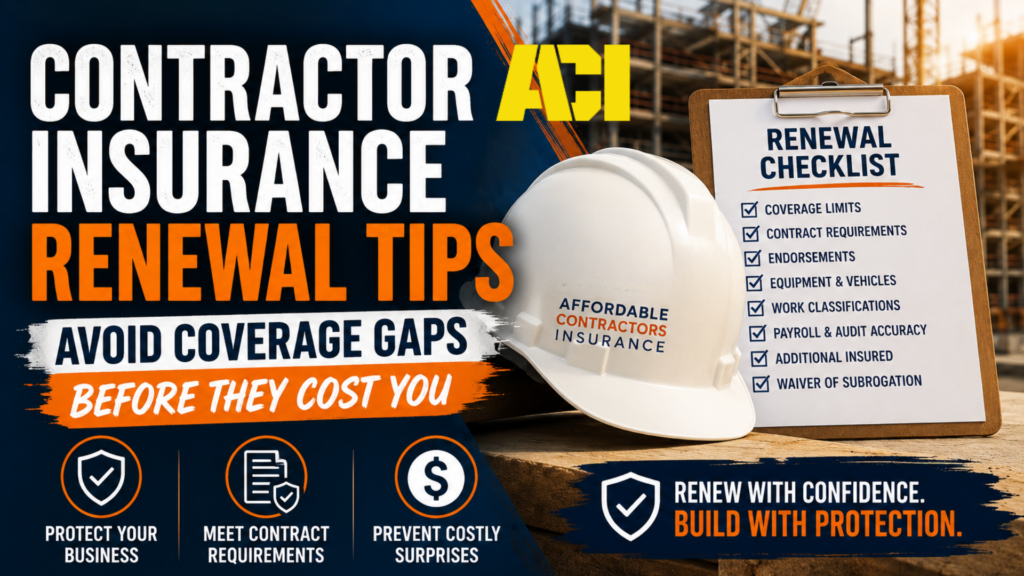
For many contractors, insurance renewal becomes another item to check off the list each year. The premium is paid, certificates are renewed, and work continues. Unfortunately, that’s also how many costly coverage issues begin.
Construction businesses change constantly. Revenue grows, new trades are added, employees come and go, equipment values increase, and contract requirements become more demanding. If your insurance policy isn’t reviewed alongside those changes, there’s a good chance your coverage no longer matches how your business actually operates.
At Affordable Contractors Insurance (ACI), we’ve seen contractors discover these problems only after a claim is filed, a certificate is rejected, or a project owner refuses to approve their insurance. By then, fixing the issue is far more expensive than preventing it in the first place.
A renewal should never be viewed as simply extending last year’s policy. It should be an opportunity to verify that your insurance still protects your business, your employees, your equipment, and your ability to win work.
Why Coverage Gaps Happen
Coverage gaps rarely happen because contractors intentionally purchase inadequate insurance. More often, they develop gradually as the business evolves while the policy remains largely unchanged.
Perhaps your company began performing larger commercial projects, expanded into new states, hired additional crews, purchased expensive equipment, or started subcontracting more work. Every one of these changes can affect your insurance needs.
Many contractors also assume that because they haven’t had a claim, their insurance must be adequate. Unfortunately, insurance isn’t truly tested until something goes wrong.
The most expensive coverage gaps are often discovered after an accident, lawsuit, property loss, or contract dispute—when changing the policy is no longer an option.
Review Your Business Before You Review Your Policy
Before renewing your insurance, take time to evaluate how your business has changed during the past year.
Ask yourself:
- Has your annual revenue increased?
- Have you hired additional employees?
- Are you performing different types of work?
- Have you purchased new vehicles or equipment?
- Are you working for larger general contractors or municipalities?
- Have your subcontractor relationships changed?
Even small operational changes can impact your liability exposure and the types of endorsements your policy should include.
Your insurance should reflect your current business—not the company you operated twelve months ago.
Make Sure Your Classifications Are Still Accurate
One of the most common issues contractors face is incorrect work classifications.
Insurance companies price policies based largely on the type of work your company performs. If your classifications no longer accurately represent your operations, you could face problems ranging from unexpected premium audits to denied claims.
For example, a contractor who originally focused on residential remodeling may now be completing commercial tenant improvements, structural work, or roofing projects. If those changes aren’t reflected in the policy, coverage questions may arise when a claim occurs.
Reviewing classifications before renewal helps ensure your policy accurately represents your operations while reducing surprises during annual audits.
Don’t Overlook Contract Requirements
Many contractors discover insurance issues when submitting certificates—not during a claim.
General contractors, developers, municipalities, and project owners often require specific endorsements, additional insured wording, waiver of subrogation provisions, primary and noncontributory language, completed operations coverage, or higher liability limits.
Simply having general liability insurance doesn’t necessarily mean your policy satisfies these contractual requirements.
Before renewing, review the contracts you’re currently working under as well as the projects you plan to pursue over the coming year. Making endorsement changes before work begins is almost always easier than trying to add them after a contract has already been signed.
Review Property, Equipment and Commercial Auto Coverage
Construction equipment has become significantly more expensive over the past several years. Trucks, trailers, tools, generators, skid steers, excavators, and specialty equipment often cost substantially more to replace today than they did just a few years ago.
If your insured values haven’t been updated recently, your business could be underinsured.
The same applies to commercial vehicles. Adding drivers, purchasing new trucks, or expanding your fleet should trigger a review of your commercial auto policy to ensure every vehicle and driver is properly covered.
Understand Your Deductibles
Many contractors focus primarily on premium, but deductibles deserve just as much attention.
Choosing a higher deductible may reduce annual premiums, but it also increases your financial responsibility when a claim occurs.
Ask yourself whether your business could comfortably absorb that deductible without affecting payroll, cash flow, or project timelines. A deductible should save money—not create financial hardship after an accident.
Know What’s Excluded
Every insurance policy contains exclusions, and understanding them is just as important as understanding what’s covered.
Depending on your policy, exclusions may involve professional services, pollution liability, employee practices, cyber incidents, faulty workmanship, or certain types of property damage.
Assuming something is covered without verifying it can create significant financial exposure.
A thorough renewal review should include discussing these exclusions with your insurance advisor so you understand where additional coverage may be appropriate.
Consider Additional Coverage as Your Business Grows
As contractors expand, standard policies may no longer provide enough protection.
Depending on your operations, additional coverage such as contractors equipment insurance, builders risk, umbrella liability, cyber liability, employment practices liability, pollution liability, inland marine coverage, or professional liability may become increasingly important.
The goal isn’t purchasing unnecessary insurance—it’s making sure your protection grows alongside your business.
Keep Your Documentation Organized
Accurate documentation makes renewals and claims significantly easier.
Maintain current equipment inventories, vehicle records, payroll information, subcontractor agreements, certificates of insurance, and photos of major assets. Organized records not only simplify claims but also help ensure your policy accurately reflects your business during renewal.
Avoid Coverage Lapses
One missed payment can create a lapse in coverage that affects future pricing, creates contract issues, and leaves your business exposed.
Setting up automatic payments, reviewing billing information regularly, and confirming renewals before expiration can help prevent unnecessary interruptions in coverage.
Schedule an Annual Insurance Review
The best insurance policies aren’t simply renewed—they’re reviewed.
An annual meeting with a contractor-focused insurance advisor allows you to identify changes in your business, review new contractual requirements, evaluate equipment values, confirm work classifications, and address potential gaps before they become expensive problems.
For growing contractors, this review often uncovers opportunities to strengthen protection while ensuring coverage continues to match the way the business actually operates.
Protect Your Business Before Renewal
Insurance renewal is one of the best opportunities each year to reduce risk, improve coverage, and avoid costly surprises.
At Affordable Contractors Insurance, we work exclusively with contractors and understand the unique insurance challenges construction businesses face. Whether you’re a small subcontractor or a large commercial contractor, our team can review your current policy, identify potential coverage gaps, and help ensure your insurance aligns with your operations and contractual obligations.
Request a free, no-obligation policy review today. We’ll evaluate your current coverage, explain any areas of concern, and help you renew with confidence—so your insurance protects your business when it matters most.