


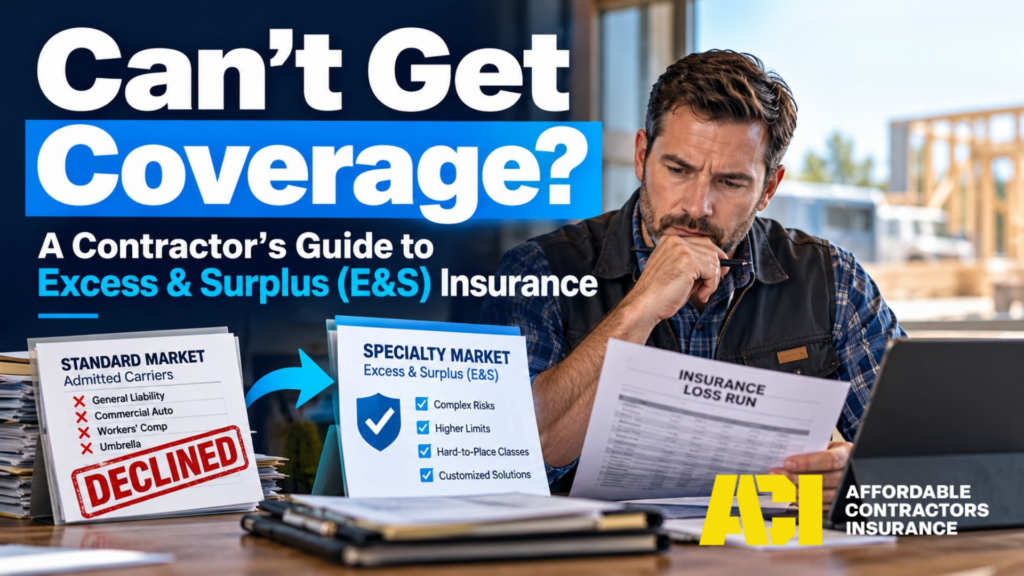
The short answer
What can a contractor do after being declined by standard insurance carriers? Look to the excess and surplus lines (E&S) market. E&S carriers are not licensed in your state, but they are legally allowed to write there through a licensed surplus lines broker, and they exist to insure risks the standard market won’t take. E&S policies are legitimate and regulated, but they often carry more exclusions, may pay defense costs inside your limits and usually lack guaranty fund protection. Read the policy carefully before you bind.
Getting declined by three carriers in a row usually doesn’t mean something is wrong with your business. It means your risk has moved outside what standard carriers want to write, because of your trade, your loss history, where you work or simply where the market is in its cycle.
Roofing, demolition, coastal and wildfire exposure, adverse claims history, residential and multifamily work, high limit requirements and new ventures with no track record all commonly end up in E&S.
Contractors who understand how E&S policies differ buy well. Contractors who assume an E&S policy works like their old standard policy tend to find out otherwise at claim time. Here’s how the market actually works.
What “non-admitted” actually means
Every state licenses the insurance carriers that do business there. A licensed carrier is admitted: its rates and policy forms are filed with the state insurance department, and its policyholders are generally protected by the state guaranty fund if it becomes insolvent.
A non-admitted (surplus lines) carrier isn’t licensed in that state, but it can legally write business there under the state’s surplus lines laws. The carrier has to meet the state’s eligibility standards, and the placement has to go through a licensed surplus lines broker.
What makes the market work is freedom of rate and form. E&S carriers don’t need state approval for their rates and policy language, so they can price a risk based on its actual exposure and write terms that fit it. That flexibility is what lets them insure risks no standard carrier will take at any filed rate.
Non-admitted does not mean unregulated or second-tier. Many large E&S writers belong to major insurance groups and carry strong financial strength ratings. States regulate surplus lines placements, maintain eligibility rules and tax the transactions. The NAIC’s overview of the surplus lines market explains how that oversight works. The difference is the regulatory path, not the legitimacy.
Admitted vs. E&S at a glance
| Admitted market | Excess and surplus (non-admitted) | |
|---|---|---|
| Licensed in the state | Yes | No, but legally eligible to write there |
| Rates and forms | Filed with the state | Freedom of rate and form |
| Guaranty fund protection | Yes, within state limits | Generally no |
| How it’s accessed | Any licensed agent | Through a licensed surplus lines broker |
| Policy forms | Largely standardized industry forms | Carrier-specific forms that vary widely |
| Flexibility on unusual risks | Limited | High |
| Taxes and fees | Included in premium | Surplus lines tax, and in many states a stamping fee, listed separately |
| Typical appetite | Standard, well-documented risks | Hard-to-place, high-hazard, adverse history, catastrophe-exposed |
Two rows drive most of the practical consequences: the lack of guaranty fund protection and the carrier-specific policy forms. Both are covered below.
How an E&S placement works
E&S placements follow different steps from a standard renewal, which is why they take longer.
- Diligent search. Most states require proof that admitted carriers declined the risk before it can go to the surplus lines market. Many states set the number at three declinations. Some states keep an export list of risk types with no realistic admitted market, which can skip this step, and certain large commercial buyers may be exempt. Your agent handles this, but it means you can’t simply choose E&S because you prefer its terms.
- Home state rules. Under federal law, the surplus lines rules and taxes of your home state (generally where your principal place of business is) govern a multistate placement.
- Retail agent to wholesale broker to carrier. Most placements run through a wholesale surplus lines broker who holds the relationships and licensing to reach non-admitted carriers. (The Wholesale & Specialty Insurance Association is the trade group for this part of the market.) That step adds time and sometimes a broker fee. It is also where market access lives: not every wholesaler reaches every carrier, and not every retail agent has strong wholesale relationships. This is the biggest single factor in whether you get a good result.
- Taxes and fees. Surplus lines tax, and in many states a stamping fee, is added to your premium and listed separately. The amount varies by state. It’s a real cost to budget for, not a hidden markup.
Why contractors end up in the E&S market
It’s rarely one reason. Usually it’s a combination of these:
- The trade itself. Some classes sit outside standard appetite. Roofing is the most common example, because of height exposure, weather-driven claims, storm restoration work and labor turnover. Demolition and excavation, scaffolding, crane and rigging, tree service, blasting, foundation work, EIFS and restoration often get similar treatment.
- Loss history. One serious claim, or a pattern of smaller ones, can push a contractor out of the standard market for several years, even when the business itself is sound.
- Residential and multifamily work. Construction defect litigation, especially on condos, townhomes and tract homes, has led many standard carriers to exclude or decline residential work. In states with heavy construction defect litigation, this is a leading reason otherwise clean contractors end up in E&S.
- Catastrophe-exposed locations. Coastal wind, wildfire-prone areas, hail-heavy regions and seismic zones all shrink standard capacity, sometimes to nothing.
- High limits. When a contract requires limits beyond what a standard program supports, the excess and umbrella layers often come from the surplus market.
- State liability laws. Some states raise contractor exposure significantly. New York’s Labor Law, which imposes strict liability on owners and contractors for many fall-related injuries, is the best-known example. Contractors working there often need specialty coverage, and many policies specifically address or exclude that exposure.
- New ventures. A contractor with no operating or loss history is an unknown, and standard carriers price for certainty.
- The market cycle. When the market hardens, standard carriers pull back across the board. Contractors who were comfortably insured for years can be non-renewed for reasons that have nothing to do with their own performance.
- Unusual operations. Mixed trades, unusual methods or specialty services that don’t fit a standard classification often need a custom policy form.
What’s different about an E&S policy
This is the section that matters most, and the one most contractors skip.
Carrier-specific forms: don’t assume anything
Standard general liability policies largely follow industry forms, so experienced contractors develop a feel for what’s covered. E&S policies are written on carrier-specific (“manuscript”) forms, and that feel doesn’t carry over. Two E&S policies for the same trade from different carriers can differ a lot. Read the policy, or have your agent walk you through it clause by clause.
The exclusions that matter most
E&S policies usually carry more exclusions than standard forms, and some change what the coverage is worth:
- Employee injury and action-over exclusions. Often the most consequential. They remove claims tied to injuries to your own employees, including when your injured employee collects workers’ comp and then sues the general contractor, who tenders the claim to you as an additional insured. That’s one of the most common serious liability claims in construction. Many general contractors screen for this exclusion, and having it can cost you work.
- Subcontractor warranty endorsements. These make coverage conditional on your subs carrying set limits, naming you as additional insured and working under written contracts. Use a sub who doesn’t meet the terms, and coverage for that work may be void. Treat this as an operational rule, not fine print.
- Classification limitations. Coverage applies only to the operations described on the policy. Work outside that description isn’t covered, which makes reporting new trades much more important than on a standard policy.
- Other common exclusions: residential work, height or elevation limits, subsidence and earth movement, EIFS, and exclusions tied to specific state liability laws.
Defense costs may reduce your limits
Most standard general liability policies, defense costs are paid in addition to the limit. On many E&S policies, defense is paid inside the limit, so every dollar spent defending a claim reduces what’s left to settle it. On a construction defect claim that’s litigated for years, defense can use up much of the limit before any settlement. Check this first on any E&S quote.
Self-insured retentions work differently from deductibles
E&S policies often use a self-insured retention (SIR) instead of a deductible. With an SIR, you generally pay first-dollar costs, often including defense, until the retention is used up, and the carrier’s obligations may not start until then. With a deductible, the carrier typically handles the claim and asks you to reimburse your share. An SIR means you need both the cash and the ability to manage claims below the retention.
Occurrence vs. claims-made
More E&S contractor liability is written on claims-made forms than in the standard market. A claims-made policy responds only to claims reported while it’s in force, so the retroactive date and extended reporting period matter a great deal. Letting a claims-made policy lapse without tail coverage can leave years of completed work unprotected.
Minimum earned premium
E&S policies commonly include a minimum earned premium: part of the premium the carrier keeps even if you cancel early. On short-term or catastrophe-exposed policies it can be a large share. Don’t bind an E&S policy planning to cancel midterm for a refund.
Little or no guaranty fund protection
In nearly every state, policies from an insolvent non-admitted carrier aren’t backed by the state guaranty fund (the NAIC notes that this protection isn’t available in the surplus lines market). That makes the carrier’s financial strength rating important, not a formality. Ask what the rating is and who issued it before you bind. You can look up a carrier yourself in AM Best’s rating search.
When a contract won’t accept non-admitted coverage
This issue catches contractors between two legitimate requirements. Many construction contracts, especially on public and institutional projects, require admitted carriers or a minimum financial strength rating. If your coverage is non-admitted (legitimate, and possibly your only option), some of those contracts will reject it.
Find this out before you bid, not after you’ve won the work and sent your certificate for review. Read the insurance section of every contract you’re pursuing, and raise any admitted-paper requirement with your agent early. Sometimes part of the program can be structured to meet it. The requirement sometimes may be negotiated. Sometimes the project isn’t a fit. Any of those beats winning work you can’t insure to contract.
How to get the best possible E&S outcome
The gap between a good and a bad E&S placement is wide, and much of what decides it is in your control.
Give underwriters a complete submission. This matters more in E&S than anywhere else, because these underwriters are pricing risks that don’t fit a formula. Include a clear description of your operations, five years of loss runs, a written explanation of any significant claims and what you changed afterward, your safety program and training records, your subcontractor insurance requirements and how you enforce them, and your hiring and driver standards. A bare application invites a defensive price or a decline.
Explain your losses honestly. Underwriters want to know whether you understand what happened and fixed it. An unexplained claim history hurts far more than an explained one.
Start early. E&S placements pass through more hands than standard renewals. Sixty to ninety days is realistic. Two weeks is not.
Use one agent. Wholesalers reach overlapping sets of carriers, so several retail agents shopping your account will collide at the same underwriters, who typically block the submission. You can lose access to markets that might have quoted. Pick one agent with strong wholesale relationships and let them run it.
Ask which markets your agent can actually reach. In E&S, market access is everything.
Before you bind: E&S quote checklist
- Are defense costs inside or outside the limits?
- Is there a self-insured retention or a deductible?
- Is the policy occurrence or claims-made? If claims-made, what’s the retroactive date?
- Is there an employee injury or action-over exclusion?
- What do the subcontractor warranty conditions require?
- Does the classification wording match all the work you do?
- What’s on the full exclusion schedule (residential, height, EIFS, earth movement)?
- What is the minimum earned premium?
- What is the carrier’s financial strength rating?
- Will the policy satisfy the contracts you’re bidding?
Getting back to the standard market
E&S isn’t necessarily permanent. Contractors move back to admitted carriers regularly, and the path is fairly consistent.
It generally takes three or more years of clean loss experience, since that’s the window most underwriters review. Standard carriers also want to see documented risk management: a written safety program with training records, a return-to-work policy, enforced subcontractor insurance requirements, hiring and driver standards, and a clear account of what changed after the losses that sent you to E&S.
Some contractors stay in the specialty market for good, and that isn’t a failure. Certain trades and locations, roofing in many states among them, are mostly written there. The goal isn’t admitted paper for its own sake. It’s the right coverage at a fair price.
Frequently asked questions
What is excess and surplus lines insurance?
Coverage written by carriers that aren’t licensed (“admitted”) in the state where the risk is located, but are legally eligible to write there through the state’s surplus lines laws. Because E&S carriers don’t file rates and forms for state approval, they can insure risks the standard market declines, on terms that reflect the actual exposure.
Is non-admitted insurance legitimate?
Yes. “Non-admitted” describes the regulatory path, not the quality of the carrier. Many E&S writers belong to major insurance groups and carry strong financial strength ratings, and states regulate surplus lines placements. The main difference is that guaranty fund protection generally doesn’t apply, so check the carrier’s rating.
Why did standard carriers decline my contracting business?
Common reasons include your trade (roofing, demolition, excavation, scaffolding and similar), loss history, residential or multifamily work, catastrophe-exposed locations, high required limits, no operating history, and a hardening market that reduces carrier appetite across the board.
Is E&S insurance more expensive?
Often, yes. Premiums reflect the actual exposure rather than a filed rate, and surplus lines taxes and, in many states, stamping fees are added. A strong submission can make a meaningful difference in the terms you’re offered.
Do E&S policies have more exclusions?
Usually. They’re written on carrier-specific forms, so terms vary widely. Check for employee injury and action-over exclusions, subcontractor warranty conditions, classification limitations, residential exclusions and height restrictions.
What does “defense inside the limits” mean?
Defense costs are paid out of your limit of liability instead of on top of it. Every dollar spent on defense reduces what’s left to settle the claim, which can sharply reduce a limit’s real value on a litigated claim.
What’s the difference between a deductible and a self-insured retention?
With a deductible, the carrier generally handles the claim and asks you to reimburse your share. With an SIR, you typically pay first-dollar costs, often including defense, until the retention is used up, and the carrier’s obligations may not start until then.
Will a general contractor accept a non-admitted policy?
Often, but not always. Some contracts, especially on public and institutional work, require admitted carriers or a minimum financial strength rating. Check the insurance requirements before you bid.
How do I get back to the standard market?
Generally through three or more years of clean loss experience plus documented risk management: a written safety program, training records, a return-to-work policy, enforced subcontractor requirements and a clear account of what changed after past losses.
A decline isn’t the end of the conversation
A decline tells you about one carrier’s appetite at one moment. It doesn’t mean your business is uninsurable, and it isn’t a reason to cut limits or go without coverage.
The E&S market exists for exactly this situation. Whether you get a workable placement depends mostly on market access and submission quality: whether your agent can reach the right carriers, and whether those carriers get enough information to underwrite you as a business, not just a class code.
Affordable Contractors Insurance works with hard-to-place contractor risks every day, including roofing, framing and carpentry, demolition and excavation, residential and multifamily work, adverse loss history and catastrophe-exposed operations. We’ll review your situation, explain what the specialty market may be able to offer and walk you through the policy terms before you bind.