


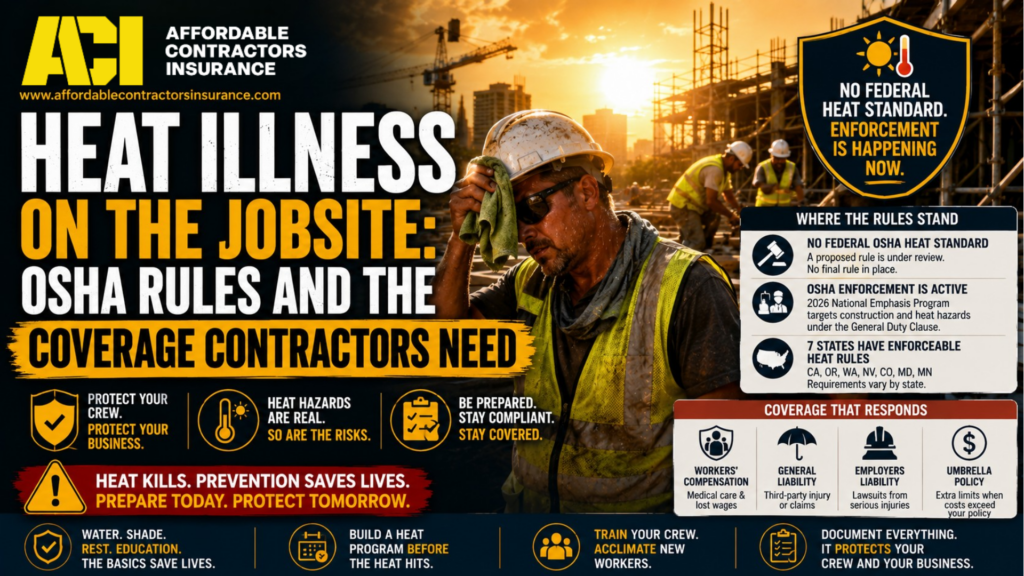
There is still no federal OSHA heat standard. There is, however, an active federal enforcement program aimed squarely at construction, seven states with their own binding heat rules, and a General Duty Clause that OSHA has used to cite employers for heat hazards for years.
That combination catches contractors off guard. Many are waiting for a federal rule before building a heat program, which is precisely backwards: enforcement is happening now, under existing authority, and a heat-related injury creates costs — workers’ compensation claims, experience modification damage, potential liability suits, and uninsurable penalties — that arrive whether or not a standard is on the books.
Here’s where the rules actually stand, what a heat injury costs a contractor, and which policies respond to which part of it.
Where the regulations stand right now
The federal standard is stalled
OSHA published a proposed rule, Heat Injury and Illness Prevention in Outdoor and Indoor Work Settings, in the Federal Register on August 30, 2024. It would apply to construction, general industry, maritime, and agriculture, and it is built around two thresholds — an initial heat trigger around an 80°F heat index requiring drinking water, break areas, and acclimatization protocols, and a high-heat trigger around 90°F bringing mandatory rest breaks and worker observation.
The rulemaking then slowed considerably. Public hearings concluded on July 2, 2025, and the post-hearing comment period closed on October 30, 2025. OSHA has not announced a target date for a final rule. The practical guidance from most compliance advisors is straightforward: do not build your heat program around the expectation that a federal standard is about to take effect.
Enforcement, however, was just renewed for five years
On April 10, 2026, OSHA issued a revised National Emphasis Program for Outdoor and Indoor Heat-Related Hazards, replacing the original 2022 directive. It took effect immediately and is scheduled to remain in place for five years.
Several changes matter directly to contractors:
- The program targets 55 high-risk industries, refreshed using OSHA and Bureau of Labor Statistics data from 2022 through 2025. Compared to the 2022 version, 46 industries were removed, 22 added, and 33 retained. Construction remains a targeted sector.
- The previous numerical inspection goal was removed, in favor of a more targeted, data-driven approach.
- Compliance officers may conduct random heat-focused inspections in high-risk industries on days when the National Weather Service issues a heat advisory or warning — and may expand any inspection where evidence of heat hazards is present.
- The directive reorganizes its appendices into clearer guidance on evaluating employer heat programs and on when citations are appropriate.
For context on the trend: OSHA has reported that heat-related inspections accounted for roughly 6% of all federal inspections over the past five years, up from about 0.5% in the five-year period preceding the 2022 program.
A National Emphasis Program is not itself a standard. It directs where inspectors go. The citation authority behind a heat case remains the General Duty Clause, Section 5(a)(1) of the Occupational Safety and Health Act, which requires employers to furnish a workplace free from recognized hazards likely to cause death or serious physical harm. Heat is a recognized hazard, and OSHA has treated it as one for years.
Seven states have their own enforceable rules
State-plan states can and do go further than federal OSHA. As of 2026, enforceable state heat illness prevention standards are in place in California, Oregon, Washington, Nevada, Colorado, Maryland, and Minnesota — though scope differs significantly, with Colorado’s rule covering agricultural employers and Minnesota’s focused on indoor workplaces.
A few specifics worth knowing:
- California maintains the most comprehensive framework, covering both outdoor and indoor work, with shade and water requirements once temperatures cross 80°F, additional high-heat procedures at 95°F, a written prevention plan, and acclimatization requirements for new workers.
- Oregon and Washington use comparable trigger points with escalating rest and cooling requirements as temperatures climb.
- Maryland’s standard took effect September 30, 2024, applying to indoor and outdoor workplaces at an 80°F heat index.
- Nevada began enforcement in April 2025, requiring employers above a small-workforce threshold to maintain a written, job-specific heat illness prevention plan with training.
- Virginia enacted legislation in 2026 that will require heat illness prevention plans beginning in 2028.
Notably for contractors in the hottest part of the country, Arizona has no enforceable heat standard. A state task force produced guidelines that are voluntary, and enforcement there still runs through the General Duty Clause. The absence of a state rule is not the absence of exposure — it simply means the obligation is defined by general duty and by what a reasonable employer in that climate should have done.
Requirements change. Before the season, confirm current obligations with your state’s occupational safety agency for every state you work in, and remember that multi-state contractors are held to the rules of the state where the work is performed.
Why construction carries a disproportionate share of the risk
Construction is consistently overrepresented in occupational heat fatalities. CPWR research published in 2025 found that construction accounted for roughly a third of U.S. occupational heat deaths despite representing a small fraction of the total workforce.
The reasons are structural, not incidental. Work is outdoors and physically demanding. Crews wear PPE that traps heat. Roof surfaces, attics, mechanical rooms, and unconditioned interiors run far hotter than ambient air. Labor turns over constantly, which means unacclimatized workers are on site all season. And the piece-rate and schedule pressure common in the trades discourages workers from stopping.
The trades with the sharpest exposure are roofing, where surface temperatures dramatically exceed the air temperature; HVAC and mechanical, working in attics and unconditioned buildings during exactly the season when systems aren’t running; concrete and paving; framing; demolition; and utility and excavation work.
Acclimatization: the detail that decides most cases
If a contractor changes only one thing after reading this, it should be this one.
A large share of serious and fatal heat incidents happen in a worker’s first few days on the job — new hires, workers returning after time off, and crews hitting the first hot stretch of the season. The human body adapts to heat over roughly one to two weeks of graduated exposure, and a worker who hasn’t gone through that process is at substantially higher risk than an experienced crew member doing identical work beside them.
This is also where OSHA looks. Under the revised enforcement program, the absence of an acclimatization plan is the kind of program deficiency that supports a citation. A schedule that phases new and returning workers into full exposure over their first week — and that treats the season’s first heat wave as an acclimatization event for everyone — is both the highest-value safety control and the most defensible documentation you can produce during an inspection.
What a heat injury actually costs, and which policy pays
This is where most heat content stops and where contractors’ real questions begin. A single serious heat event can generate costs across four different places, and only some of them are insurable.
| The cost | What responds | The catch |
| Employee medical treatment and lost wages | Workers’ compensation | Heat illness is generally a compensable occupational injury; severe cases can become catastrophic or fatal claims |
| Higher premiums for years afterward | Nothing — this is the indirect cost | Claims drive your experience modification factor, which multiplies premium across future policy periods |
| A lawsuit that gets around workers’ comp exclusivity | Employer’s liability (Part B of the WC policy), umbrella/excess above it | Default employer’s liability limits are often low; third-party-over actions are the common route |
| OSHA citations and penalties | Not insurable | Fines and penalties generally can’t be insured as a matter of public policy; only defense cost coverage may be available |
Each of those deserves a closer look.
Workers’ compensation is the primary coverage
Heat exhaustion, heat stroke, and related conditions arising out of employment are generally compensable workers’ compensation claims, covering medical treatment and wage replacement. Heat stroke in particular can produce catastrophic outcomes — organ damage, permanent neurological injury, death — which turns what began as a hot afternoon into one of the largest claims a contractor will ever have.
General liability does not cover employee injury. That’s a common and costly misunderstanding: GL responds to third-party bodily injury and property damage, and employee injuries are excluded because workers’ compensation is the mechanism designed for them.
The experience modification factor is the hidden multiplier
Workers’ compensation premium is driven by payroll, classification rates, and your experience modification factor — a number reflecting your claims history relative to expected losses for your class. A serious claim raises that factor, and the increase follows you across multiple policy periods.
That produces a cost most contractors underestimate. The direct cost of a heat claim is the claim itself. The indirect cost is years of elevated premium on every dollar of payroll, plus the bidding consequences: many general contractors and owners set an experience modification threshold for prequalification, so a damaged number can cost you access to work entirely.
Employer’s liability and the action-over problem
Workers’ compensation is generally the exclusive remedy for an injured employee against their employer, but that exclusivity has edges — and construction’s contracting structure creates the most common one.
Here’s the pattern. A subcontractor’s employee suffers heat stroke and receives workers’ compensation benefits from the sub. The employee then sues the general contractor and the property owner, who aren’t his employer and aren’t protected by exclusivity, alleging they controlled site conditions and failed to provide a safe workplace. The GC then turns to the subcontract’s indemnification provision and demands the subcontractor defend and indemnify them.
That claim lands back on the subcontractor — through employer’s liability coverage and through contractual liability under the general liability policy. It’s known as an action-over or third-party-over claim, and it’s the primary way a heat injury becomes a liability loss rather than just a comp loss.
Two practical implications follow. First, review your employer’s liability limits, which frequently sit at low default amounts that bear no relationship to a catastrophic injury claim. Second, confirm that your umbrella or excess policy sits over employer’s liability, not just over general liability and auto — that’s a coverage detail contractors rarely check and one that matters enormously in exactly this scenario.
OSHA penalties are not insurable
Contractors sometimes assume a policy will absorb an OSHA citation. It won’t. Fines and penalties are generally uninsurable as a matter of public policy in most states.
What may be available is defense cost coverage — some carriers offer endorsements or services that reimburse legal expenses associated with responding to an OSHA inspection or contesting a citation, without paying the penalty itself. If you operate in a targeted industry with random heat-advisory-day inspections now authorized, it’s worth asking your agent whether that’s available on your program.
There’s also a downstream consequence people forget: a citation becomes part of the public record, and a serious violation in a heat case is documentary evidence a plaintiff’s attorney will use in the action-over suit that follows.
What a defensible heat program contains
Whether or not your state has a standard, a written program built on the following elements protects your crews, supports a General Duty Clause defense, and demonstrates the kind of risk management that underwriters price favorably.
A written, site-specific plan that identifies heat hazards for your actual work and assigns responsibility for monitoring conditions.
Water, rest, and shade. Cool drinking water in adequate quantity and accessible location; scheduled rest breaks that increase with temperature; and shade or a cooling area available whenever crews need it, not only when someone asks.
A real acclimatization schedule for new hires, returning workers, and the season’s first heat wave — phased exposure over roughly the first week.
Trigger-based procedures tied to the heat index rather than to raw temperature, since humidity substantially changes physiological load. Escalating controls at defined thresholds gives supervisors an objective rule instead of a judgment call.
Training in a language every worker understands, covering symptom recognition, hydration, the obligation to report symptoms without fear of consequence, and emergency procedures.
Monitoring and a buddy system, especially for workers in enclosed spaces, on roofs, and in heavy PPE. Altered mental status — confusion, slurred speech, stumbling, unusual behavior — separates heat exhaustion from heat stroke and is a medical emergency.
A written emergency response plan with the site address posted and understood, clear instructions to call emergency services immediately for suspected heat stroke, and instructions to begin aggressive cooling right away rather than waiting for transport. Rapid cooling is what determines outcomes in exertional heat stroke.
Scheduling and engineering controls: early starts, shifting the heaviest work to the coolest hours, rotating crews, mechanical assistance to reduce exertion, shade structures, and ventilation in enclosed spaces.
Documentation of all of it — training rosters, daily temperature and heat index logs, break schedules, acclimatization records, and incident reports. Documentation is what converts a good program into a defensible one during an inspection or a lawsuit.
Common mistakes contractors make
- Waiting for a federal standard while enforcement proceeds under the General Duty Clause and state rules.
- Assuming no state rule means no obligation. General duty applies everywhere, and in a hot climate the “recognized hazard” argument writes itself.
- Skipping acclimatization, which is both the leading contributor to serious incidents and an identified program deficiency for citation purposes.
- Using air temperature instead of heat index, which understates risk badly in humid regions.
- Treating heat as a productivity issue rather than a recordable-injury and claims issue.
- Carrying default employer’s liability limits with no umbrella sitting above them.
- Not knowing the rules of every state you work in, since obligations follow the jobsite.
- Training once and never documenting it. An undocumented program is functionally no program during an inspection.
- Culture that discourages reporting. Piece-rate pressure and fear of being sent home produce workers who hide symptoms until they collapse.
- Failing to report or record properly, creating recordkeeping violations on top of the underlying hazard.
What it costs — and what it saves
A heat program is inexpensive relative to nearly everything else on a jobsite. Water, shade structures, cooling supplies, a heat index monitor, and training time are minor line items. The costs they offset are not: workers’ compensation claims, years of elevated experience modification, potential action-over liability, OSHA penalties that no policy will pay, project delays, and the loss of bidding eligibility when a modification factor crosses a prequalification threshold.
There’s an underwriting dimension too. When a broker markets your workers’ compensation and general liability, underwriters are evaluating how you manage predictable exposures. A documented heat program with training records and trigger-based procedures is exactly the kind of evidence that supports better terms — particularly for contractors in hot-climate states where underwriters know the exposure is real.
A realistic scenario
Two mechanical contractors have crews installing rooftop and attic equipment in late July, both with new hires who started that Monday.
The first has a written plan tied to heat index, an acclimatization schedule that keeps new workers at reduced exposure through their first week with a supervisor checking in, water and a shaded cooling area staged at the truck, and documented training. On Thursday a new worker reports dizziness. He’s moved to shade, cooled, evaluated, and sent home. There’s an incident report, no lost time, and no claim.
The second treats the first hot week as a normal week. A new hire works a full attic shift on day three, says nothing because he doesn’t want to look weak, and collapses that afternoon with heat stroke. The result is an emergency transport, a catastrophic workers’ compensation claim, an experience modification hit that raises premium for years, an OSHA inspection triggered by the hospitalization report — with no acclimatization plan to show — and, eventually, a suit against the GC that comes back to the sub through the subcontract’s indemnity clause.
The controls that would have prevented the second outcome cost almost nothing. The absence of them cost nearly everything.
Pre-season checklist
- Confirm the current heat rules in every state where you have crews.
- Write or update a site-specific heat illness prevention plan.
- Build acclimatization into onboarding and into the season’s first heat wave.
- Set trigger thresholds using heat index, and define what changes at each one.
- Train every worker in a language they understand, and document it.
- Post site addresses and confirm crews know the emergency procedure for suspected heat stroke.
- Review workers’ compensation classifications and your current experience modification factor.
- Check your employer’s liability limits and confirm your umbrella sits over them.
- Review subcontract indemnity provisions and the insurance requirements flowing to and from you.
- Ask your agent about OSHA defense cost coverage availability.
- Keep daily temperature, break, and training records through the season.
Frequently asked questions
Is there a federal OSHA heat standard?
No. OSHA proposed a Heat Injury and Illness Prevention rule in August 2024, but it has not been finalized and no target date has been announced. OSHA currently cites heat hazards under the General Duty Clause, Section 5(a)(1) of the OSH Act, and directs inspections through its National Emphasis Program on heat-related hazards.
What is the OSHA Heat National Emphasis Program?
It’s an enforcement directive that focuses OSHA inspections and outreach on heat hazards. A revised version issued April 10, 2026 targets 55 high-risk industries, including construction, remains in effect for five years, and authorizes random heat-focused inspections in those industries on days when the National Weather Service issues a heat advisory or warning.
Which states have their own heat illness rules?
As of 2026, California, Oregon, Washington, Nevada, Colorado, Maryland, and Minnesota have enforceable heat illness prevention standards, though scope varies — Colorado’s applies to agriculture and Minnesota’s addresses indoor workplaces. Virginia has enacted requirements taking effect in 2028. Verify current requirements with the relevant state agency, since this area is changing rapidly.
Is heat illness covered by workers’ compensation?
Generally yes. Heat exhaustion, heat stroke, and related conditions arising out of employment are typically compensable occupational injuries covered by workers’ compensation, including medical treatment and wage replacement, with death benefits in fatal cases.
Does general liability cover an employee’s heat injury?
No. General liability covers third-party bodily injury and property damage, and employee injuries are excluded. Employee heat injuries fall under workers’ compensation, with employer’s liability coverage responding to certain suits that fall outside workers’ comp exclusivity.
Can I insure against OSHA fines?
No. Fines and penalties are generally uninsurable as a matter of public policy. Some carriers offer endorsements or services covering the legal defense costs of responding to an inspection or contesting a citation, but not the penalty itself.
What is an action-over claim in a heat illness case?
It’s when an injured employee, having collected workers’ compensation from their employer, sues another party such as the general contractor or owner, who then seeks indemnity from the employer under the subcontract. The claim returns to the subcontractor through employer’s liability and contractual liability coverage, which is why employer’s liability limits and umbrella coverage over them matter.
Why does acclimatization matter so much?
Because a disproportionate share of serious and fatal heat incidents involve workers in their first days on a job or returning after time away. The body needs roughly one to two weeks of graduated exposure to adapt, and the absence of an acclimatization plan is both a leading cause of incidents and a program deficiency OSHA looks for.
Review the program and the policy together
Heat is one of the few jobsite hazards where the safety response and the insurance response are genuinely inseparable. The controls that keep a worker out of an ambulance are the same controls that keep a claim off your experience modification, keep an inspector from finding a program deficiency, and give you a defensible position if an action-over suit follows.
If you’re not certain where your employer’s liability limits sit, whether your umbrella extends over them, how your current experience modification is affecting what you pay, or what your obligations are in each state where you have crews, those are worth reviewing before the next heat wave rather than after an incident.
Affordable Contractors Insurance works with contractors nationwide on workers’ compensation, general liability, umbrella and excess coverage, and hard-to-place E&S risks — including trades and classes standard carriers decline. Request a coverage review and we’ll walk through both the exposure and the program that reduces it.
This article is general information, not legal advice, and regulatory requirements change. Confirm current obligations with OSHA or your state occupational safety agency.