


The short answer
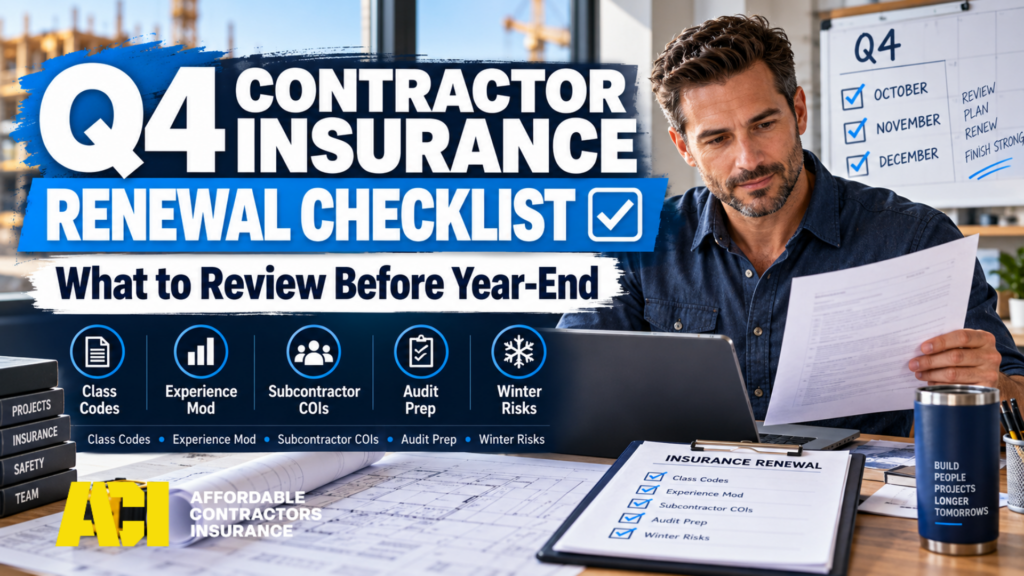
When should contractors start their insurance renewal? About 90 days before the renewal date. For a January 1 renewal, that means early October. Use Q4 to document what changed in your business, check classification codes and your experience mod, clean up your subcontractor certificate file, prepare for the premium audit and protect jobsites from winter losses.
Many contractor policies renew on January 1 or early in the first quarter. That makes Q4 your last real chance to influence next year’s coverage and cost. It is also when underwriters are at their busiest.
Contractors who start in December usually take what the market offers. Contractors who start in October get time to correct errors, present a complete submission and fix problems before they are priced in.
Q4 is also when a year of unreported change catches up with you: new states, new trades, more trucks, bigger projects, higher payroll. Most of it surfaces at audit or at claim time, which is the worst time to find it. The checklist below covers what to review, in what order and when.
Step 1: Inventory what changed this year
Before you look at a policy, write down how your business is different from twelve months ago. Most renewal problems trace back to a change nobody reported.
Work and revenue
- Is revenue materially higher or lower than the estimate your policy was based on?
- Are you performing new trades or scopes? This is the most commonly missed item, and the one most likely to create an uncovered claim, because coverage is built around your classified operations.
- Has your mix shifted between residential and commercial, or new construction and remodel? Both affect classification and carrier appetite.
- Are your projects larger? Limits, builder’s risk values and bonding capacity all need to keep pace.
- Are you subcontracting more or less of your work?
Geography
- Are you working in any new states? This is the second most commonly missed item (see the callout below).
- Has your operating radius grown for vehicles or crews?
People and equipment
- How have headcount and payroll changed, and what do you project for next year?
- Have you added or sold vehicles? Is the vehicle schedule accurate?
- Have you bought equipment that isn’t on your inland marine schedule?
- Any changes in ownership, officers, entity structure, DBAs or acquisitions?
Contracts
- Are you signing agreements with higher insurance requirements than you’ve carried before?
- Have any prequalification programs raised their thresholds?
Thirty minutes on this list before the renewal conversation is the highest-value time in the whole process.
Callout: working in a new state
If you’ve expanded into a new state, two things need attention before crews mobilize.
Check where your workers’ comp policy actually applies. Workers’ compensation follows the state where work is performed. Your policy lists states in two places: Item 3.A (states where you have operations and full coverage) and Item 3.C (other states where coverage may extend if you start work there mid-term). Coverage under 3.C has conditions and notice requirements, and it is not a substitute for listing a state where you already have ongoing work. If a state isn’t listed at all, ask your agent before you send a crew.
Watch for monopolistic states. North Dakota, Ohio, Washington and Wyoming require workers’ comp to be purchased from a state fund, not a private carrier. Those state fund policies generally don’t include employer’s liability coverage, so contractors working there typically need stop gap employer’s liability added to their general liability policy. Contractors who assume their existing program travels with them can be left without employer’s liability protection and not know it until a claim.
Step 2: Review each policy line by line
| Coverage line | What to verify |
|---|---|
| General liability | Limits and aggregates; products-completed operations aggregate; class codes and revenue basis; exclusions compared to the work you actually do; additional insured forms on file |
| Workers’ compensation | Class codes; payroll by class; experience mod worksheet; states listed in 3.A and 3.C; officer inclusion or exclusion; stop gap where needed |
| Commercial auto | Vehicle schedule; driver list and motor vehicle records; hired and non-owned auto; radius; newly acquired vehicle provisions |
| Tools and equipment / inland marine | New purchases; scheduled vs. blanket limits; rented and leased equipment; valuation basis (replacement cost or actual cash value) |
| Builder’s risk | Active projects and expiration dates; projects running into next year; termination triggers; deductibles |
| Umbrella / excess | Underlying schedule; whether it sits over employer’s liability, not just GL and auto; whether it follows form for additional insured status |
| Commercial property | Building and business personal property at current replacement cost; yard and storage exposures |
| Professional liability | Worth reviewing if you do any design, design-build or delegated design work |
| Cyber and crime | Payment fraud and social engineering coverage (see below) |
| Surety / bonds | Capacity for next year’s pipeline; timing of financial statements |
Does your umbrella sit over employer’s liability?
Many contractors carry an umbrella over GL and auto without confirming it also sits over employer’s liability. In an action-over claim, an injured employee collects workers’ comp, then sues the general contractor, who seeks indemnity from you. That one gap can decide whether the claim is covered. Ask the question directly.
Are equipment values current?
Contractors often insure equipment at what they paid, not what it would cost to replace today. Check the schedule against current pricing, and confirm whether losses settle at replacement cost or actual cash value.
Are you covered for payment fraud?
Contractors are frequent targets of social engineering fraud: fake emails that redirect progress or vendor payments to a criminal’s account. Standard crime coverage often limits or excludes losses where an employee was tricked into authorizing the transfer, and general liability does not respond. If you send or receive payments by wire or ACH, ask what your program covers and what the sublimit is.
Step 3: Gather your renewal documents
A renewal is only as strong as the submission your agent puts in front of underwriters. Assemble:
- Loss runs for every line, ideally five years. Request them early; carriers can be slow.
- Experience mod worksheet, checked for errors. Misattributed claims, missing subrogation credits, duplicate entries and payroll mismatches are more common than most contractors expect.
- Payroll by class code, with the overtime premium portion separated where your state allows it.
- Subcontractor certificates for every sub, covering the full period they worked for you.
- Additional insured endorsements themselves, not just certificates.
- Safety program, training records and toolbox talk documentation.
- Return-to-work policy, if you have one.
- Claim explanations for any significant loss, including what you changed afterward.
- Contract insurance requirements across active and pending agreements.
- Revenue and payroll projections for next year.
Don’t skip the projections. Estimates that are well off produce either a surprise audit bill or a year of overpaying, and neither is necessary.
Step 4: Get ready for the premium audit
Audits usually follow the end of the policy period. Q4 is the time to make sure your records are audit-ready, not to rebuild them under pressure later.
The most common causes of surprise audit bills:
- Subs without valid certificates. Carriers often treat those payments as your own payroll and charge premium on both workers’ comp and general liability.
- Sub invoices that don’t split labor and materials. The full invoice amount can end up in your rating basis.
- Missing payroll-by-class records. Auditors may assign payroll to the highest-rated class involved.
- Misclassified workers. People paid as independent contractors may be reclassified as employees under state tests.
The audit works from what you can produce. Close the documentation gaps now.
Step 5: Address winter and year-end exposures
Q4 brings seasonal risks, most of them on jobsites that sit unattended or partly built in cold weather.
- Holiday theft. Holiday closures leave sites empty longer than any other time of year. Secure or remove copper, high-value materials, tools and equipment, and confirm your theft deductible, which is often separate and higher on builder’s risk.
- Freeze damage. Unenclosed or unheated structures are exposed to frozen and burst pipes, one of the most common cold-weather construction losses. These claims often hit the builder’s risk water damage deductible, frequently the largest on the policy. Drain or heat systems, protect installed plumbing and document what you did.
- Snow and ice. Snow load on partial structures and temporary coverings, ice damage, and slip-and-fall liability on walkways and access routes.
- Idle equipment. Confirm machinery is secured and covered while in storage, which is not always the same as coverage in use.
- Seasonal payroll. If payroll dips in winter, make sure projections reflect the full year, not a peak-season run rate.
- Projects crossing year-end. Any builder’s risk policy that expires before the project finishes needs an extension arranged before it expires. Carriers are much less flexible afterward.
Step 6: Match coverage to next year’s work
Renewal is the moment to insure the business you’re about to run, not the one you just finished.
- Bigger projects: confirm limits still meet the contracts you’ll sign and that bonding capacity supports your backlog.
- New states: resolve licensing and workers’ comp before crews mobilize.
- New trades: confirm classification, and check that no exclusion sits over the new work.
- Higher contract requirements: price the added coverage into your bid, rather than finding it after award.
The pattern to avoid: winning work in January that the policy you bound in December can’t support.
The Q4 renewal calendar (for a January 1 renewal)
Shift the dates if your policy renews at a different time; the 90-day sequence stays the same.
| When | What to do |
|---|---|
| Early October | Complete the change inventory. Request loss runs for all lines. Pull your experience mod worksheet and check it for errors. |
| Late October | Review class codes and payroll allocation. Ask carriers to close resolved claims and review open reserves. Audit your subcontractor certificate file. |
| Early November | Assemble the underwriting package: safety program, training records, return-to-work policy, claim explanations and projections. |
| Mid-November | Your agent markets the account. Work with one agent per market to avoid blocked submissions. Confirm no builder’s risk policy expires mid-project. |
| Early December | Compare quotes on coverage forms and exclusions, not price alone. Check limits against contract requirements. Confirm the umbrella sits over employer’s liability. |
| Mid-December | Bind. Confirm endorsements are actually issued: additional insured, primary and noncontributory, waiver of subrogation. Winterize and secure active jobsites. |
| January | Send updated certificates to GCs and owners. Update your compliance calendar. Start audit prep. |
10 questions to ask your agent before renewal
- What exclusions are on my general liability policy, and does any of my regular work fall outside coverage?
- Does my umbrella sit over employer’s liability?
- Are my class codes right for what my crews actually do?
- Is anything on my experience mod worksheet wrong?
- Am I covered in every state where I have crews, and do I need stop gap anywhere?
- What happens at audit if I can’t produce a certificate for a sub?
- Which builder’s risk policies expire before their projects finish?
- Do my limits still meet the contracts I’m signing?
- What does my program cover if a payment is redirected by a fraudulent email?
- Which markets can you access if my carrier non-renews me?
The last question matters most in a tight market. A lot of contractor coverage is written in the excess and surplus lines market, including roofing, accounts with adverse loss history, coastal and wildfire exposure, and unusual operations. An agent without strong E&S relationships may have few options when a standard carrier walks away.
Frequently asked questions
When should contractors start the insurance renewal process?
About 90 days before the renewal date. For a January 1 renewal, start in early October. Waiting longer means competing for underwriter attention in the busiest stretch of the year, with little time to fix class codes or claim reserves before quotes are prepared.
What documents do I need for a contractor insurance renewal?
Loss runs for all lines, your experience mod worksheet, payroll by class code, current subcontractor certificates, additional insured endorsements, your safety program and training records, explanations of significant claims, contract insurance requirements, and revenue and payroll projections for next year.
Do I need to tell my agent if I start working in a new state?
Yes, before crews mobilize. Workers’ comp follows the state where work is performed, and coverage in states not listed on your policy is limited or conditional. Licensing, classification and rating also vary by state.
What are monopolistic states, and what is stop gap coverage?
North Dakota, Ohio, Washington and Wyoming require workers’ comp to be purchased from a state fund. Those policies generally don’t include employer’s liability, so contractors working there typically add stop gap employer’s liability to their general liability policy.
What happens if I don’t report business changes to my carrier?
You risk uncovered claims for work outside your classified operations, large audit bills when payroll or revenue exceeds estimates, and disputes over vehicles or equipment never added to a schedule. These issues tend to surface at the worst possible time.
How do I prepare for a premium audit?
Keep payroll organized by class code, separate overtime premium where allowed, collect valid certificates from every sub for the full period they worked, and require subs to split labor and materials on invoices.
Should I switch carriers at renewal to save money?
Only after comparing coverage forms and exclusions, not just price. A cheaper policy with a residential exclusion, height restriction or employee injury exclusion is less coverage, not a better deal. Carrier continuity can also help with underwriting and claims.
What if a project runs past my builder’s risk expiration date?
Arrange an extension before the policy expires. Carriers are much less flexible after expiration and may decline to extend a delayed project. Flag every project that crosses year-end during your October review.
Use the quarter while you still have it
Most renewal outcomes are decided before anyone requests a quote. Your class codes, your experience mod, your subcontractor file and how completely your business is presented to underwriters all shape next year’s coverage and cost. In October, all of them can still be changed. By late December, you’re mostly taking what the market offers.
Affordable Contractors Insurance works with contractors nationwide on general liability, workers’ compensation, commercial auto, builder’s risk, umbrella and excess, and hard-to-place E&S risks that standard carriers decline. Our team can verify your class codes, check your mod worksheet, review exclusions against the work you actually do and make sure your program supports next year’s pipeline.
Request a renewal review and we’ll walk through this checklist with you. Need an updated certificate for a GC or owner?